
Long Story ShortReadHide
- What it is: Northern Europe's best-preserved wooden old town, whitewashed cottages on cobbled lanes above the Vågen harbour.
- Who it suits: people who want to live inside a piece of heritage on the water, and do not mind visitors, small houses and no supermarket at the door.
- What it costs: protected, rarely-traded heritage stock; no separate figure is published, so we show the Stavanger area average of about 55,000 kr per m².
- What people complain about: cruise-season crowds, and heritage rules with no conveniences inside.
First impressions
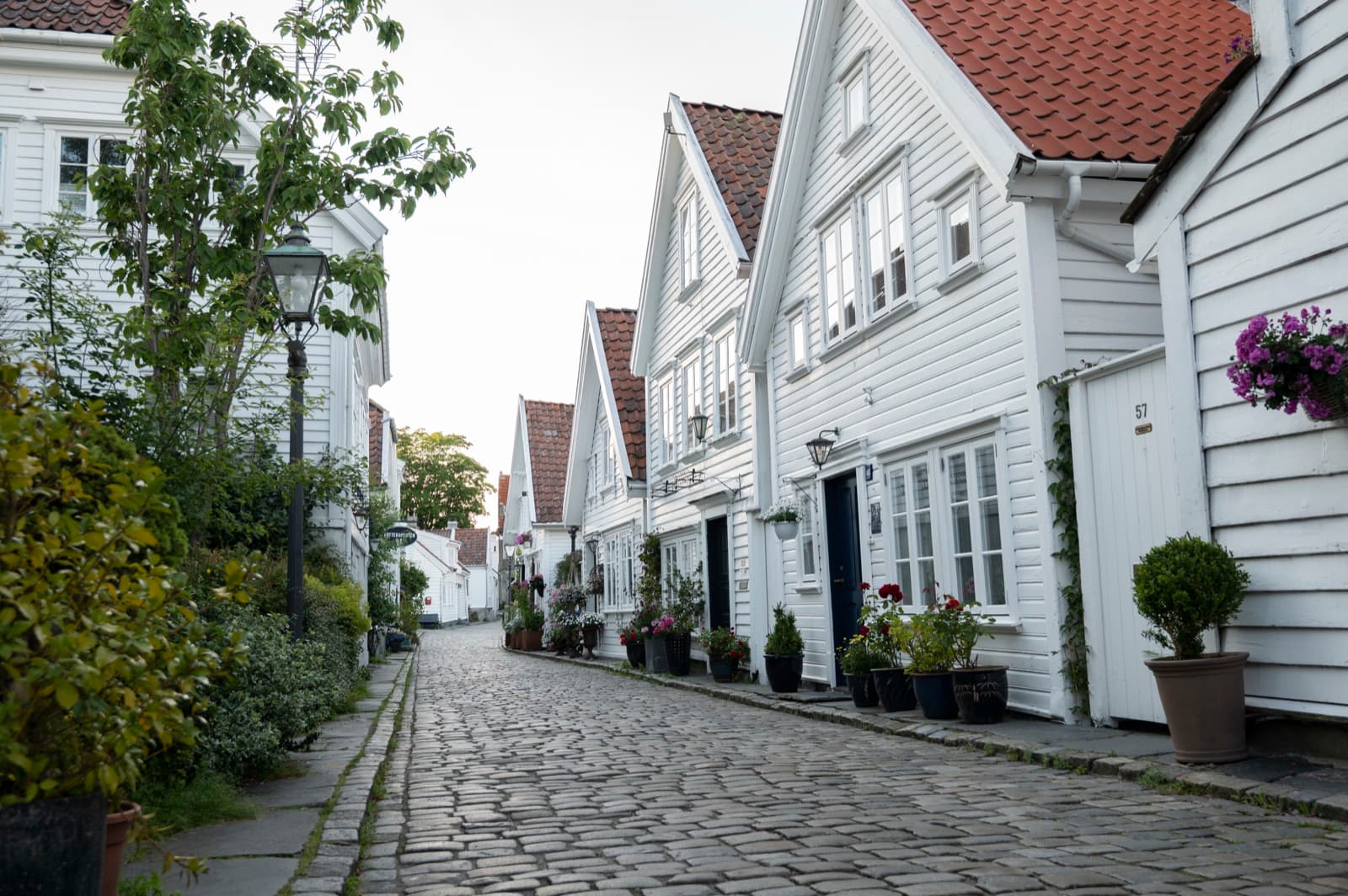
Gamle Stavanger is the postcard, and people live in it. It is the preserved wooden old town on the western slope above Vågen, the inner harbour, a run of 173 protected white cottages along cobbled lanes, the best-kept wooden settlement in Northern Europe. The Norwegian Canning Museum sits in its heart, a reminder that this was the city's sardine-tinning quarter, and the harbour is at the foot of the lanes.
It is historic, central and quiet, beautiful and much-visited, a lived-in residential quarter that also happens to be the city's top sight.
This is one of the most special addresses in Norway, and it lives at a walking pace behind its own front doors.
Who lives here, and what the streets look like
Gamle Stavanger is a small, established, affluent heritage pocket rather than a mixed neighborhood; the protected cottages are strictly kept and rarely change hands. The people who live here have chosen a piece of history and its constraints.
The streetscape is the whole point: whitewashed wooden cottages on cobbled, car-free lanes, stepping down toward the harbour, with strict upkeep and no modern intrusions. It is lovely to walk and unforgiving of prams and wheels.
Getting around
Gamle Stavanger is a walking quarter. The lanes are pedestrian, cobbled and car-restricted, so residents walk out to the harbour and the central terminals, all within about ten minutes on foot. Torget and Vågen are five minutes away, Stavanger station and the Fiskepiren fast-ferry terminal about ten, and Kolumbus buses and the airport coach run from the adjacent centre. The one catch is that the cobbles and steps are not step-free.
Typical weekday minutes from Øvre Strandgate, with the icon showing how. Times via Google Routes API for a typical weekday around 08:00, measured from the neighborhood centre; the icon shows the fastest sensible way (walk, bike, transit or car)., 2026-08.
Daily life
Day to day, Gamle Stavanger sends you a few steps into the centre. There is no supermarket inside the protected quarter, so residents shop in the adjacent city centre, where the usual chains all trade, and the nearest café and shop life is the Skagen and Strandkaien harbour front and the colourful Fargegata a short walk east. For food delivery, Foodora and Wolt both cover Stavanger.
Local Places Worth Knowing
Independent and close by, chosen on merit. Nobody pays to appear here. Links are being confirmed.
The old sardine-canning factory museum on Øvre Strandgate, run with the Printing Museum as IDDIS, with summer sprat-smoking.
An independent fishmonger and seafood restaurant on the harbour at Strandkaien, selling the day's local catch.
View on Google MapsAn independent café, bar and bookshop on the colourful Fargegata, a short walk east across the harbour.
View on Google MapsA creative plant-based restaurant on Støperigata, seasonal and locally sourced.
View on Google MapsChecked August 2026. Places close and change, so tell us if something here is out of date.
Schools and families
Gamle Stavanger is a small heritage quarter rather than a family suburb, but the schools are close in the surrounding centre. The nearest lower-secondary is Kannik skole, and Kampen skole covers the primary years, with kindergartens in the wider area. Norway publishes school results through Udir, but not at a per-district grain, so we do not rate schools here. Stavanger has free school choice, so it is worth checking admission before you sign a lease or purchase.
Kids Restricted. Quiet, safe and largely traffic-free, with the Canning Museum and the harbour right there, but the heritage cottages are small, the cobbles are steep and uneven, and there are few playgrounds inside the quarter, so families lean on the nearby city-centre parks.
Pet Restricted. Dogs are common and the Vågen harbour promenade and the nearby Bjergstedparken and Byparken give good on-leash walks, but the old town itself is tight cobbled lanes with no yards or off-leash space.
Green space, leisure and eating out
Gamle Stavanger's outdoors is the harbour and the lanes. The Vågen promenade wraps the water, and the quarter is dense with culture: the Canning Museum and Printing Museum, the Maritime Museum on Nedre Strandgate, and the Bjergsted park and concert hall just north. Eating and drinking cluster on the Skagenkaien and Strandkaien harbour front and along Fargegata a few minutes east.
What it costs
Gamle Stavanger is a tiny protected conservation zone whose cottages are regulated and rarely come to market, so no reliable per-area price is published; we show the Stavanger area average of about 55 334 NOK / m² (about €5,000 / m²) ≈ $540 / sq ft (Krogsveen, which folds in Sandnes), and the rare heritage stock here sits above it. Rent is set by the market rather than any first-hand system, so no local figure exists; the wider Stavanger two-room market runs around 11 400 NOK / mo (about €1,000 / mo) (SSB, 2025).
Weather and climate
Seasonal averages for Stavanger, one representative month per season. MET Norway 1991-2020 normals (Stavanger-Sola) via Wikipedia climate box.
The honest downsides
Tourist and cruise footfall. As the city's most iconic address, right on the cruise route, the lanes fill with visitors and photographers in season, which cuts into the quiet and privacy of a lived-in quarter.
Heritage constraints, cost and no conveniences inside. The houses are protected, so owners face strict renovation rules and high upkeep, the cottages are small and rarely for sale, and the pedestrianised quarter has no supermarket and effectively no parking, with cobbles and steps that are not step-free.
Crime and safety
Gamle Stavanger is a quiet residential lane set back from the Vågen and Skagen bar strip, and Norway does not publish neighborhood-level crime figures, so there is no local number. Central Stavanger, like most Norwegian city centres, sees the usual weekend-night disorder and occasional petty theft among the crowds rather than problems on the old-town lanes. Any begging or rough sleeping is around the central squares and harbour, not concentrated in the residential old town. The fuller Stavanger picture is on the city safety page.
Is this you?
If you want to live inside a piece of preserved history on the water, walk to the centre in minutes, and take the visitors and the heritage rules as part of the deal, Gamle Stavanger is one of the most special addresses in the country. If you want space, a supermarket downstairs and easy parking, a mainland district will suit you far better.
Want to know what homes here are actually worth?
Join the waitlistHow we source this
How we put this together. Gathered on the ground by our local field team and written up by the Apraiz research team. Every figure above carries its own source and date. The scores are not computed by the build; walking and transport will use open map and transit data first, then Apraiz's own model. We update prices quarterly, transport and amenities twice a year, and school data when the source publishes.
Sources: Krogsveen prisstatistikk, Statistics Norway (SSB), Leiemarkedsundersøkelsen, Wikipedia / IDDIS, Statistics Norway (SSB), table 08487.
Safety and crime in Stavanger →