
Long Story ShortReadHide
- What it is: a leafy, affluent villa suburb on the hillsides above the Oslofjord, quiet and family-oriented, with beaches and forest close by.
- Who it suits: families who want a house, a garden and the fjord, and are happy to commute into the city by train.
- What it costs: an expensive suburb; the per-m² figure of about 83,000 kr understates it, because this is a villa market where whole-house prices run high.
- What people complain about: steep, car-leaning streets and a slow, stairs-only train, and a quiet with little urban buzz.
First impressions
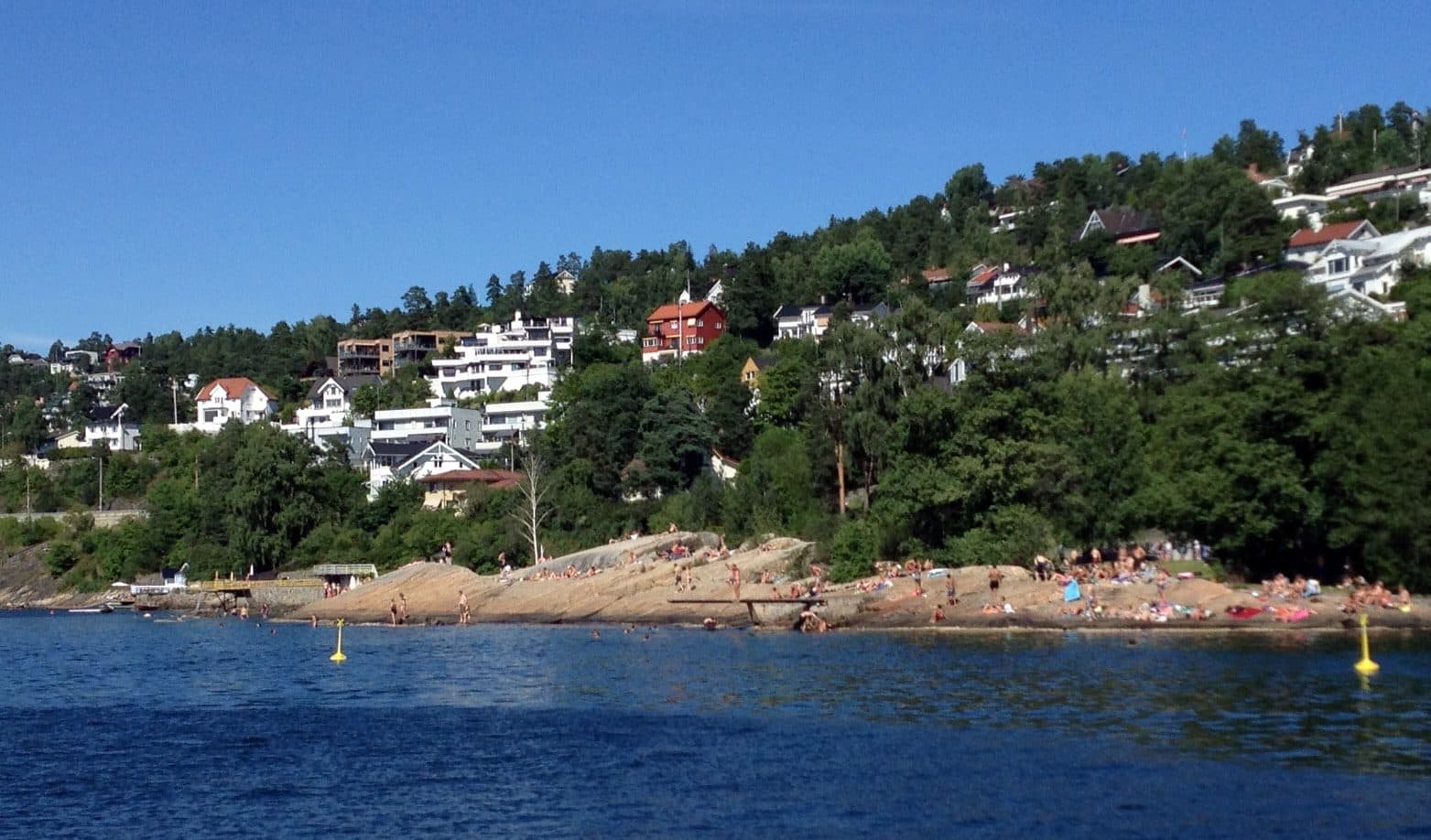
Nordstrand is Oslo's classic villa suburb. It climbs the hillsides above the Oslofjord in the city's south-east, a quiet, affluent spread of detached houses and gardens with the water below, the forest above, and a tidy local centre at Sæter torg. It began as a summer-house colony and became a year-round suburb once the railway arrived in 1880.
It is green, calm and family-oriented, an address of villas, fjord views and beaches rather than street life. It is also hilly and a little remote: life here leans on the car and the local train rather than the pavement.
This is a settled, leafy, well-off suburb, and it is the opposite of the inner-city districts in almost every way.
Who lives here, and what the streets look like
Nordstrand draws families and established older residents, drawn by the houses, the schools and the fjord. It is one of Oslo's long-standing prosperous suburbs, and Solveien has been among the city's most expensive addresses since the early 1900s.
The streetscape is villas and gardens: older detached houses and 1970s homes on streets that climb steeply from the fjord toward Ekebergåsen, with a compact, walkable centre at Sæter torg. It is quiet, green and low-density, and errands on foot involve real gradients.
Getting around
Nordstrand is not on the metro, despite its Oslo address. It runs on the local Østfoldbane train and buses, with the Nordstrand station about six minutes from Oslo Central Station, though only around twice an hour and up a flight of stairs, since the station is not step-free. Sæter is the local bus interchange. The centre of town is a short train hop, but the villa streets themselves are hilly and car-leaning. Note that the fjord ferries depart from the centre at Aker Brygge, not from Nordstrand itself, so that is an amenity you reach after the train.
Typical weekday minutes from Nordstrand stasjon, with the icon showing how. Times via Google Routes API for a typical weekday around 08:00, measured from the neighborhood centre; the icon shows the fastest sensible way (walk, bike, transit or car)., 2026-08.
Daily life
Day to day, Nordstrand is Sæter torg. The rebuilt local centre gathers a supermarket, pharmacy, bakery, café, bookshop and florist in one walkable core, with Meny and Rema 1000 for the weekly shop. It is a tidy, everyday centre serving a well-off residential population rather than a buzzing high street. For food delivery, Foodora and Wolt both serve the area, and Oda handles the grocery run.
Local Places Worth Knowing
Independent and close by, chosen on merit. Nobody pays to appear here. Links are being confirmed.
The local branch of the Oslo coffee house at Sæter torg, with its own bakery goods and ice cream.
View on Google MapsThe full-range supermarket at Sæter torg, the anchor grocery of the local centre.
View on Google MapsThe area's signature fjord bathing cove below Mosseveien, with rock ledges, a sandy patch, diving boards and a kiosk.
A family sit-down restaurant with a broad menu, the most reliable full restaurant in this quiet villa centre.
View on Google MapsChecked August 2026. Places close and change, so tell us if something here is out of date.
Schools and families
Nordstrand is one of Oslo's prime family suburbs, and schools are a large part of why people move here. It has its own primary schools, Nordstrand skole and Ljan skole, and its own lower-secondary, Nordstrand ungdomsskole, which opened in 2021, along with plenty of kindergartens. Because the ungdomsskole is new, no stable leaving average is published yet. Oslo has free school choice, so it is worth checking admission before you sign a lease or purchase.
Kids Friendly. One of Oslo's prime family suburbs, with its own primary and lower-secondary schools, kindergartens and the shallow fjord bathing spot at Katten; the caveats are steep terrain for a pram and a stairs-only train station.
Pet Friendly. A low-density villa area with private gardens, quiet streets, fjord-side walking paths and forest close by; the national leash rule applies from 1 April to 20 August.
Green space, leisure and eating out
Nordstrand's green is the fjord and the forest. Katten is the local bathing cove below Mosseveien, with rock ledges, a sandy patch, diving boards and a kiosk, and the historic Nordstrand Bad shoreline runs along the same edge. The hillside rises north to the Ekebergåsen forest and viewpoints, and the fjord parkland around Hvervenbukta and Ljan lies to the south. Eating out is modest and local, from Kaffebrenneriet to Egon; serious restaurant choice is a short train ride away in the centre.
What it costs
Nordstrand is an expensive, affluent suburb, though its cost is easy to misread. Flats change hands at about 83 044 NOK / m² (about €7,600 / m²) ≈ $810 / sq ft (Krogsveen, second quarter of 2026), which sits below the Oslo average, but that per-m² figure understates the real cost here: this is a detached-house market, and whole-villa prices run well above the flat rate. Rent is set by the market rather than any first-hand system, so no local figure exists; the wider Oslo two-room market runs around 15 260 NOK / mo (about €1,400 / mo) (SSB, 2025).
Weather and climate
Seasonal averages for Oslo, one representative month per season. MET Norway 1991-2020 normals (Oslo-Blindern) via Wikipedia climate box.
The honest downsides
Hilly and car-leaning. The villa streets climb steeply from the fjord, walking and cycling are hard work, and winters ice up, so many households rely on a car despite the train, which runs only about twice an hour from a stairs-only station.
Expensive, and thin on urban buzz. It is a polished, established address where entry is costly, and it is a quiet residential suburb with limited nightlife, dining or shopping variety, with the real city a commute away.
Crime and safety
Nordstrand is a quiet, affluent villa suburb, regarded locally as a safe place to raise children. Norway does not publish neighborhood-level crime figures, so there is no local number, and it is worth noting that this villa area is separate from bydel Søndre Nordstrand further south, which has a different profile. In a residential hillside suburb with no tourist or nightlife draw, visible street homelessness or begging is minimal to effectively absent day to day. The fuller Oslo picture, and the reporting caveats, are on the city safety page.
Is this you?
If you want a house with a garden, the fjord and the forest at the end of the street, good schools and a quiet place to raise a family, and you are happy to commute in by train, Nordstrand is one of Oslo's most desirable suburbs. If you want to live car-free, walk to the shops on the flat, or have the city's nightlife at your door, an inner district will suit you far better.
Want to know what homes here are actually worth?
Join the waitlistHow we source this
How we put this together. Gathered on the ground by our local field team and written up by the Apraiz research team. Every figure above carries its own source and date. The scores are not computed by the build; walking and transport will use open map and transit data first, then Apraiz's own model. We update prices quarterly, transport and amenities twice a year, and school data when the source publishes.
Sources: Krogsveen prisstatistikk, Statistics Norway (SSB), Leiemarkedsundersøkelsen, Wikipedia / Nettavisen, Statistics Norway (SSB), table 08487.
Safety and crime in Oslo →Nearby: Grünerløkka · Frogner · Majorstuen