
Long Story ShortReadHide
- What it is: Oslo's trendy inner-east, a flat grid of pre-war blocks along the Akerselva where old textile mills are now homes, cafés and culture spaces.
- Who it suits: young professionals and anyone who wants to live car-free in the middle of the action, and does not mind small flats or weekend noise.
- What it costs: above the city average, about 108,000 kr per m² to buy, a little dearer than Oslo as a whole.
- What people complain about: busy bar streets at night, and small, old apartments without lifts or parking.
First impressions
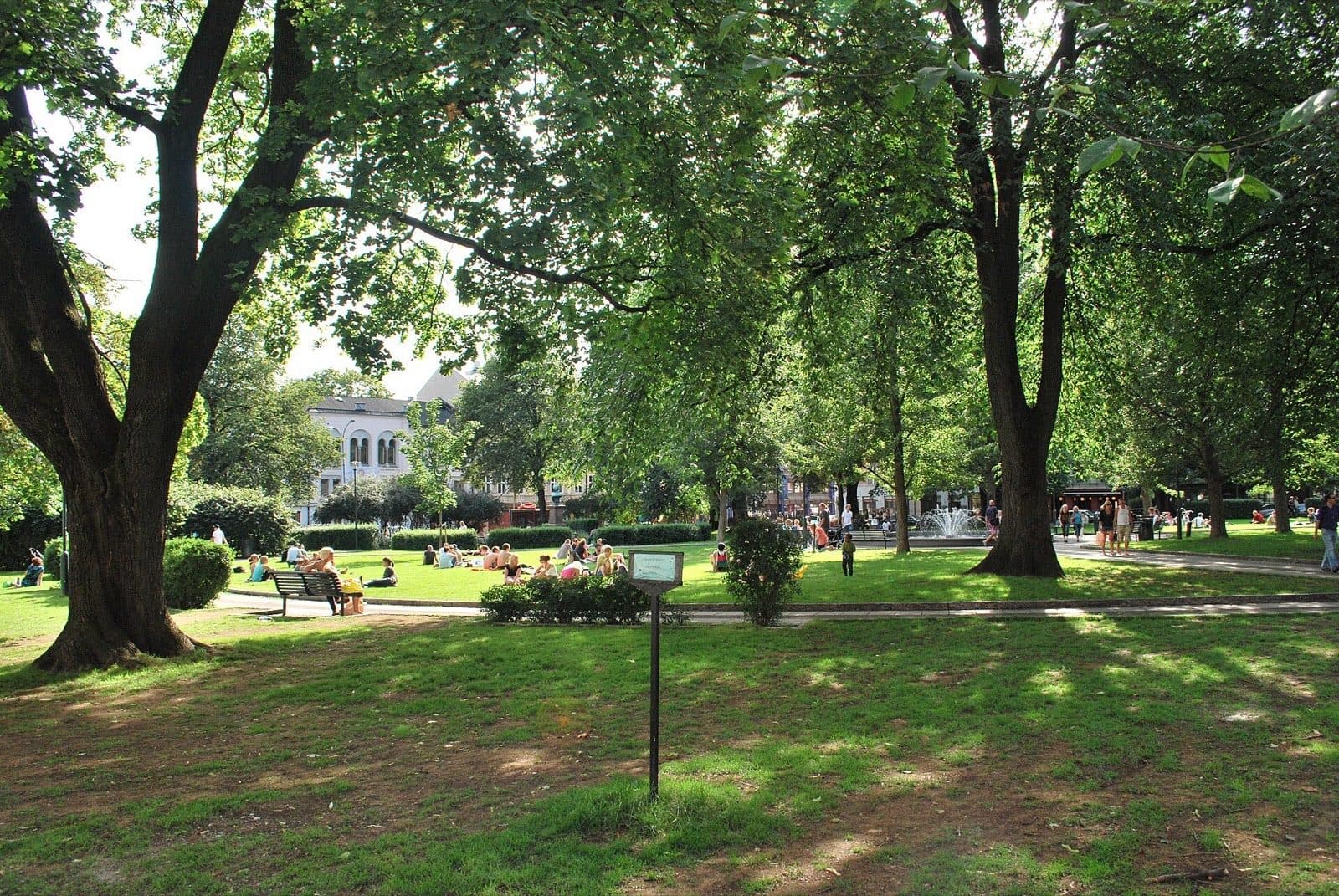
Grünerløkka, "Løkka" to everyone who lives here, is the district Oslo reaches for when it wants to show off its cool side. It is a dense, flat grid of 1870s and 1880s apartment blocks laid over the east bank of the Akerselva, the river whose waterfalls once powered the city's textile mills. Those brick mills are still here, converted into homes, offices and culture venues, and the water still runs through the middle of it all.
The spine is Thorvald Meyers gate, a long, busy run of independent cafés, bakeries, vintage and design shops and small restaurants that thickens around the two big squares, Olaf Ryes plass and Schous plass. It is the kind of place people move to in their twenties and thirties and then quietly refuse to leave.
This is a gentrified, much-loved, much-walked neighborhood, and it knows exactly what it is.
Who lives here, and what the streets look like
Grünerløkka grew up as a working-class quarter on the "wrong side" of the river and spent the last few decades becoming the opposite. Today it draws young professionals above all, with a broad mix of ages and backgrounds still threaded through the older blocks.
The streetscape is the draw and the constraint. It is flat, gridded and continuous, with ground floors given over to coffee bars, shops and bars, and the Akerselva green corridor running down one edge. It is lovely to walk and easy to cycle, and it is busy, especially along Thorvald Meyers gate and around the squares on a warm evening.
Getting around
Grünerløkka runs on trams rather than the metro. Lines 11, 12 and 13 run straight through it down Thorvald Meyers gate, stopping at Olaf Ryes plass, Schous plass, Birkelunden and Nybrua, so the centre is only a few minutes away. The T-bane does not cross the core; the nearest stations are on the ring at the edges, Carl Berners plass to the north-east and Grønland and Tøyen to the south.
Above all it is walkable and cyclable: flat, central and small, with the Akerselva path a car-free route right into town.
Typical weekday minutes from Olaf Ryes plass, with the icon showing how. Times via Google Routes API for a typical weekday around 08:00, measured from the neighborhood centre; the icon shows the fastest sensible way (walk, bike, transit or car)., 2026-08.
Daily life
Day to day, Løkka is coffee, bakeries and small shops. The everyday grocers are close, with Kiwi at Schous plass and Rema 1000 at Vulkan and Lakkegata, and a Coop Extra down at the Grønland edge. The high street is Thorvald Meyers gate, a browse of independent cafés, vintage and design shops rather than chains. For food delivery, Foodora and Wolt both cover the district, and Oda handles the grocery run.
Local Places Worth Knowing
Independent and close by, chosen on merit. Nobody pays to appear here. Links are being confirmed.
A world-renowned single-origin roastery and espresso bar on Grüners gate, going since 2007.
View on Google MapsA small, family-run French bistro and wine bar on Søndre gate, listed in the Michelin Guide as a Bib Gourmand.
View on Google MapsA European-style indoor food hall in the old Vulkan foundry at the river's edge, with around thirty food shops and eateries.
View on Google MapsThe leafy, heritage-protected square with its pavilion and Paulus church, and a much-loved Sunday flea market.
Checked August 2026. Places close and change, so tell us if something here is out of date.
Schools and families
Grünerløkka is a young, urban district that is increasingly raising families too. The nearest lower-secondary school is Sofienberg skole, for grades 8 to 10, right by Sofienbergparken, with Frydenberg skole at the borough's northern edge; the local primary schools are Grünerløkka skole and Lakkegata skole. Norway publishes school results through Udir, but not at a per-district grain, so we do not rate schools here. Oslo has free school choice, so it is worth checking admission before you sign a lease or purchase.
Kids Friendly. Flat, pram-friendly streets with playgrounds and open lawns at Sofienbergparken, Olaf Ryes plass and Birkelunden; the trade-offs are small apartments and busy bar streets on weekend nights.
Pet Friendly. Plenty of green for a dog, with Sofienbergparken, Birkelunden, Kuba and the Akerselva path, plus a fenced dog run at Sverdrups plass; the main catch is that the pre-war flats are small.
Green space, leisure and eating out
Grünerløkka's green is the river and the squares. The Akerselva path runs the length of it, past waterfalls, old brick factories and the street art around Blå, and Sofienbergparken gives the district its big open lawn, with Birkelunden and its Sunday flea market a few blocks north. Leisure here means the cafés and the culture: Mathallen food hall in the old Vulkan foundry, the live jazz and club nights at Blå, and Parkteatret on Olaf Ryes plass. Eating out is one of Oslo's densest and most independent scenes, heavy on specialty coffee by day and small restaurants and bars by night.
What it costs
Grünerløkka sells at a premium to the city. Flats here change hands at about 108 128 NOK / m² (about €9,800 / m²) ≈ $1,060 / sq ft, above the Oslo average of roughly 98,000 kr (Krogsveen, second quarter of 2026). The housing is characterful and often small, 1870s and 1880s blocks where you pay for the address and the atmosphere rather than for space, lifts or parking. Rent is set by the market, not by any first-hand system, so no Grünerløkka-only figure is published; the wider Oslo two-room market runs around 15 260 NOK / mo (about €1,400 / mo) (SSB, 2025).
Weather and climate
Seasonal averages for Oslo, one representative month per season. MET Norway 1991-2020 normals (Oslo-Blindern) via Wikipedia climate box.
The honest downsides
Weekend noise and crowds. The terraces around Olaf Ryes plass and Thorvald Meyers gate fill from mid-afternoon and stay busy late, and venues like Blå run club and live nights into the small hours. It is lively if you want it, tiring if you live above it.
No longer cheap, and dense old stock. Gentrification has pushed prices to the higher end of Oslo's east side, and much of the housing is small 1870s and 1880s flats, often without a lift or parking.
Crime and safety
Grünerløkka is a busy, well-used and generally safe part of Oslo, popular with young professionals and visitors alike. Pickpocketing is uncommon in Norway and is mostly a risk in crowds and on busy trams rather than a neighborhood problem, and serious crime is rare on these streets. As in much of central Oslo, you may occasionally notice someone sleeping rough or asking for change near the busier squares and transit stops, but it is not a defining feature of daily life here. Norway publishes crime only city-wide, with the fuller picture, and the reporting caveats, on the Oslo safety page.
Is this you?
If you want to live car-free in the middle of Oslo's most walkable, most caffeinated district, in a characterful old flat with a tram at the corner and the river a block away, Grünerløkka is hard to beat. If you need space, quiet evenings and a parking spot, the calmer residential districts up the hill or out toward the fjord will suit you better.
Want to know what homes here are actually worth?
Join the waitlistHow we source this
How we put this together. Gathered on the ground by our local field team and written up by the Apraiz research team. Every figure above carries its own source and date. The scores are not computed by the build; walking and transport will use open map and transit data first, then Apraiz's own model. We update prices quarterly, transport and amenities twice a year, and school data when the source publishes.
Sources: Krogsveen prisstatistikk, Statistics Norway (SSB), Leiemarkedsundersøkelsen, Wikipedia / Life in Norway, Statistics Norway (SSB), table 08487.
Safety and crime in Oslo →Nearby: Frogner · Majorstuen · Grønland