
Long Story ShortReadHide
- What it is: Oslo's most multicultural quarter, a dense, lively market district just east of the central station, packed with cheap eats, grocers and bars.
- Who it suits: people who want to live in the middle of everything, cheaply for how central it is, and who value character over polish.
- What it costs: below the city average; no separate figure is published, so we show the Oslo average of about 98,000 kr per m², which overstates it here.
- What people complain about: grit and noise, and a real, documented street-drug problem.
First impressions
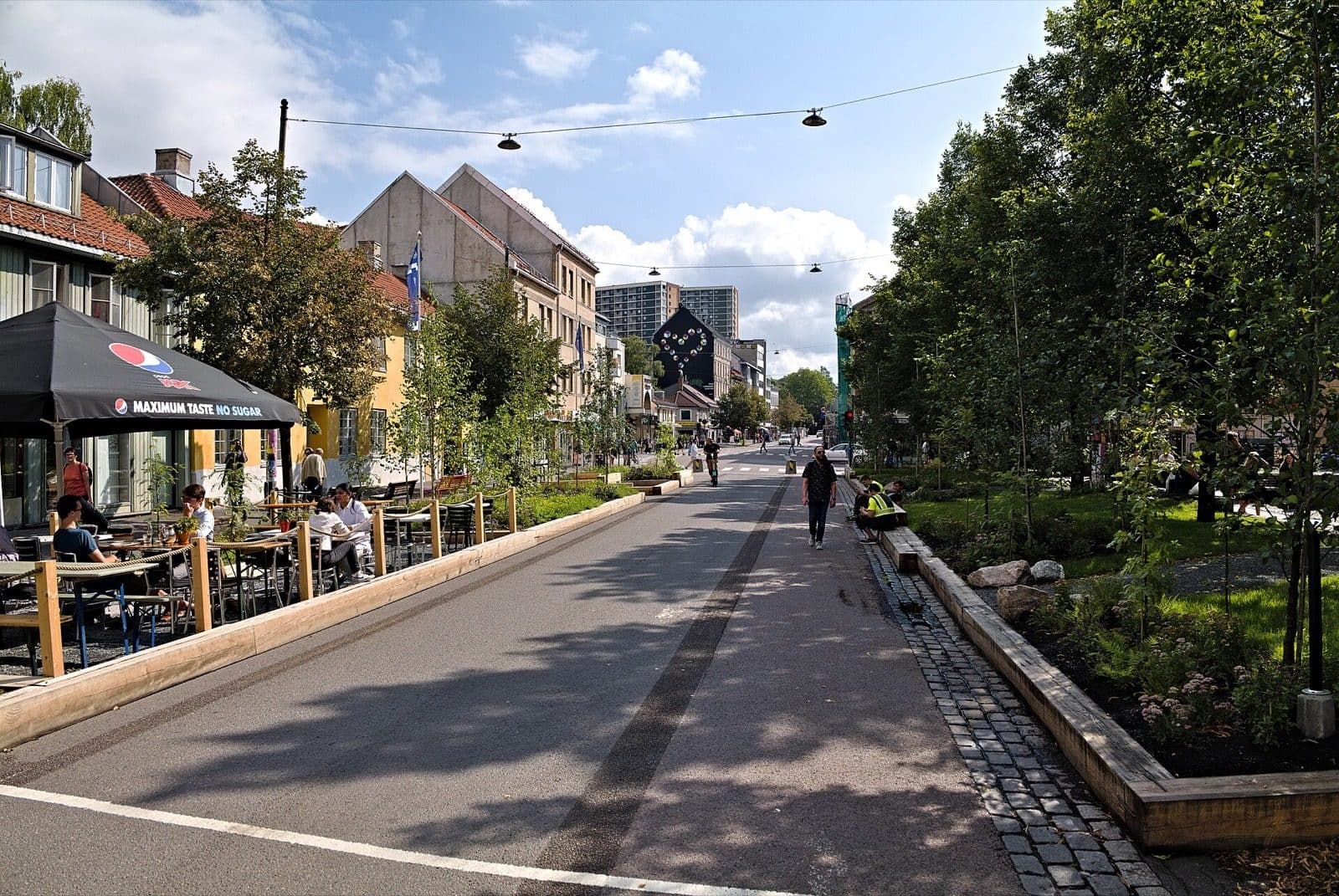
Grønland is Oslo's melting pot. A few minutes' walk east of the central station, it is a dense, flat quarter of market streets, grocers, cheap and excellent food from every corner of the world, and a nightlife that runs late. The Grønland Basar sits at its heart, and the streets around it are the most diverse in the city.
It is central, cheap for how central it is, and unpolished, an everyday, practical district rather than an upscale one. It is also the part of the inner city with the most visible street problems, which the police actively work on.
This is a lively, mixed, characterful neighborhood, and it is honest about being a work in progress.
Who lives here, and what the streets look like
Grønland has a long-standing immigrant and working-class population, with a broad mix of ages, and it draws students and young professionals for the low rents and the location. The market streets have been a place of arrival for over a century.
The streetscape is dense and busy: grocers, butchers, spice shops and cafés at street level, the Basar under one roof, and little private green. It is flat and walkable, and it is crowded, loud and lived-in rather than tidy.
Getting around
Grønland is about as central as Oslo gets. Grønland metro station sits on the common tunnel, so every metro line calls here, and Oslo Central Station is a short walk or one stop away. The whole downtown is five to ten minutes on foot. It is flat and completely walkable.
Typical weekday minutes from Grønland T-bane, with the icon showing how. Times via Google Routes API for a typical weekday around 08:00, measured from the neighborhood centre; the icon shows the fastest sensible way (walk, bike, transit or car)., 2026-08.
Daily life
Day to day, Grønland is the market. The everyday chains are here, with a Kiwi inside the Grønland Basar and Rema 1000 and Coop nearby, but the draw is the market streets: Middle Eastern, South Asian, African and Turkish grocers, butchers and spice shops, and some of the best-value eating in Oslo. For food delivery, Foodora and Wolt both cover the district, and Oda handles the grocery run.
Local Places Worth Knowing
Independent and close by, chosen on merit. Nobody pays to appear here. Links are being confirmed.
A compact multicultural shopping centre on Grønlandsleiret, with grocers, a Kiwi supermarket, a pharmacy, the wine monopoly and cafés under one Middle-Eastern-styled roof.
View on Google MapsA historic beer hall and restaurant on Grønlandsleiret, open since 1899, serving Scandinavian home cooking under crystal chandeliers.
View on Google MapsA cosy café and pub in a merchant's house from around 1730, known for its courtyard beer garden.
View on Google MapsA long-running café, bar and courtyard hangout, a Grønland institution for coffee by day and drinks by night.
View on Google MapsChecked August 2026. Places close and change, so tell us if something here is out of date.
Schools and families
Grønland is a lively, central district rather than a classic family suburb, but families do live here and the infrastructure is close. The nearest lower-secondary school is Jordal skole, for grades 8 to 10, and Vahl skole covers the primary years, with kindergartens and playgrounds around. Families here tend to lean on Tøyenparken and the Botanical Garden a few minutes uphill rather than the immediate market streets. Norway publishes school results through Udir, but not at a per-district grain, so we do not rate schools here. Oslo has free school choice, so it is worth checking admission before you sign a lease or purchase.
Kids Restricted. A lively, adult-leaning district with nightlife, but with real family infrastructure nearby: Vahl primary school, kindergartens, playgrounds and the parks a few minutes uphill, which is where families tend to head.
Pet Restricted. Dense inner-city blocks with small flats and little private green, but Tøyenparken and the Botanical Garden are a short walk uphill; the busy market streets mean crowds and traffic.
Green space, leisure and eating out
Grønland's green is uphill: Tøyenparken, a big hilltop park a short walk east, and the Botanical Garden, Norway's oldest, with its Victorian glasshouses and free outdoor entry. Leisure here is the food and the nightlife, one of Oslo's densest and most diverse strips, from falafel and kebab to Pakistani and Turkish tables and historic spots like Olympen, Kafe Asylet and Dattera til Hagen.
What it costs
Grønland is one of the more affordable central districts, and that is a large part of its appeal. No Grønland-specific sale price is published, so we show the Oslo city average of about 98 021 NOK / m² (about €8,900 / m²) ≈ $960 / sq ft; in practice, prices here typically sit below that. Rent is set by the market rather than any first-hand system, so no local figure exists; the wider Oslo two-room market runs around 15 260 NOK / mo (about €1,400 / mo) (SSB, 2025).
Weather and climate
Seasonal averages for Oslo, one representative month per season. MET Norway 1991-2020 normals (Oslo-Blindern) via Wikipedia climate box.
The honest downsides
It is gritty and busy. Heavy foot traffic, noise, litter and nightlife spillover on the market streets, with little private green in the immediate blocks.
A real street-drug problem. Everyday-safety perception is a genuine local topic: the police have described parts of Grønland as being, in effect, controlled by drug dealers, and set up a dedicated unit in 2024 to curb open dealing and associated crime. It is something buyers weigh against the low prices and the location.
Crime and safety
Grønland is central and lively, but it has a real, documented street-environment challenge. Oslo police have described parts of the area as being to a large degree run by drug dealers and, in 2024, set up a dedicated unit to curb open dealing, violence and threats on Grønland and neighbouring Tøyen. In a local survey, about a fifth of area residents said they felt unsafe in their neighborhood, and the city has run improvement projects with mixed results. As in much of central-east Oslo you will at times see people who are visibly homeless, using substances or asking for money on the main streets. Norway publishes crime only city-wide, with the fuller picture, and the reporting caveats, on the Oslo safety page.
Is this you?
If you want to live in the middle of Oslo's most diverse, most affordable central quarter, with the best cheap food in the city at the door, and you take the grit as part of the deal, Grønland rewards you. If you want polish, quiet and a green outlook, the calmer districts west or up the hill will suit you better.
Want to know what homes here are actually worth?
Join the waitlistHow we source this
How we put this together. Gathered on the ground by our local field team and written up by the Apraiz research team. Every figure above carries its own source and date. The scores are not computed by the build; walking and transport will use open map and transit data first, then Apraiz's own model. We update prices quarterly, transport and amenities twice a year, and school data when the source publishes.
Sources: Krogsveen prisstatistikk, Statistics Norway (SSB), Leiemarkedsundersøkelsen, Aftenposten / VG, Statistics Norway (SSB), table 08487.
Safety and crime in Oslo →Nearby: Grünerløkka · Frogner · Majorstuen