
Long Story ShortReadHide
- What it is: a long riverside district on the Nemunas's right bank, working-class in origin and wooden-house in texture, now drawing a younger, creative crowd to its cheaper, characterful streets.
- Who it suits: young buyers, artists and students who want river access and character for less money and do not mind a rough-edged, in-between feel.
- What it costs: one of the more affordable inner districts, about 2 056 EUR / m² ≈ $220 / sq ft to buy on the outside-centre anchor.
- What people complain about: patchy, part-industrial fabric, and a long, linear shape with an upper-lower split that leaves the far ends feeling cut off.
First impressions
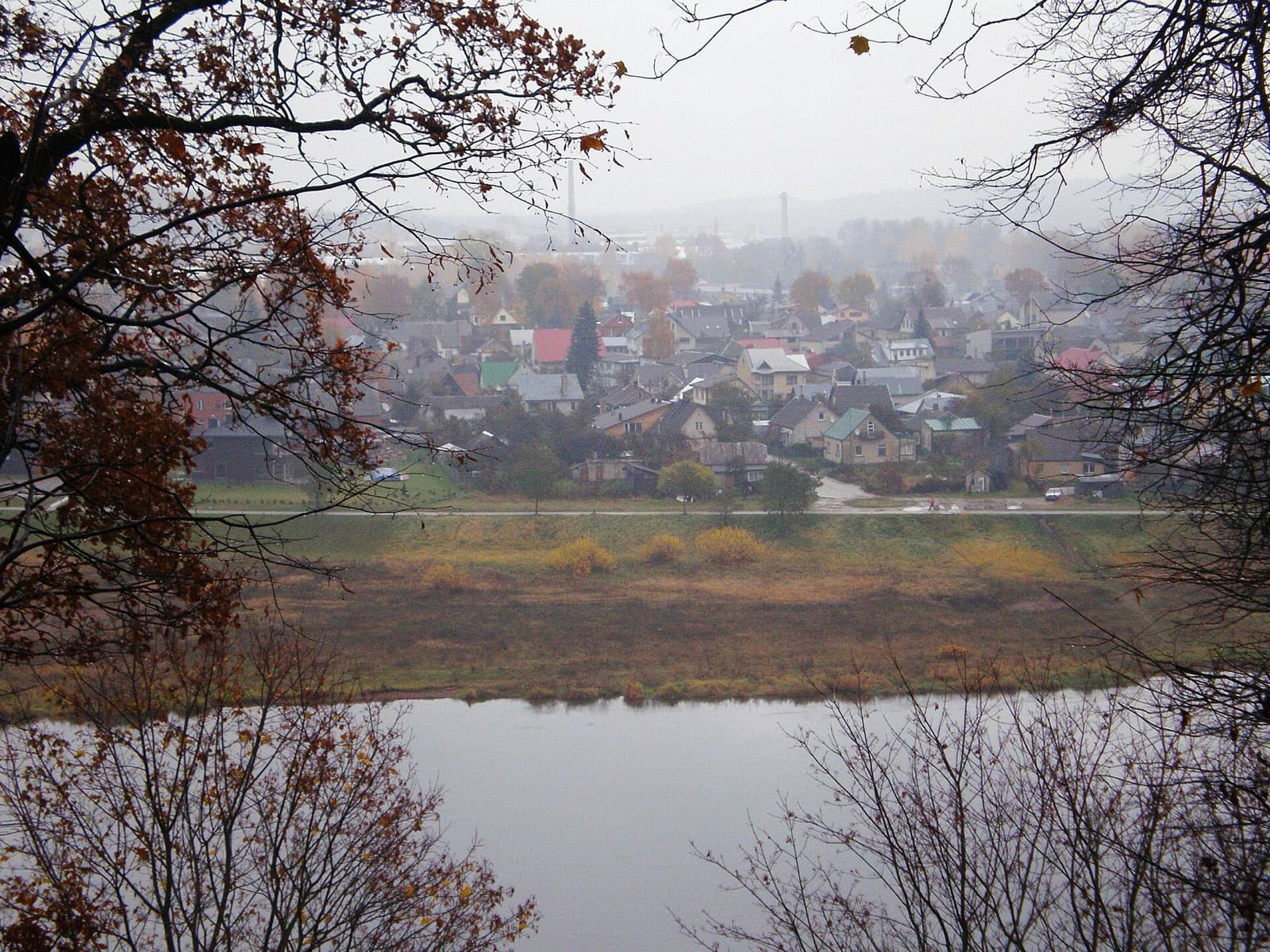
Šančiai stretches along the meandering right bank of the Nemunas, south-east of the centre, splitting into Žemieji Šančiai, Lower Šančiai in the river valley, and Aukštieji Šančiai, Upper Šančiai on the hill above. The texture is low wooden and brick houses, old industrial and railway land, long river frontage, and the red-brick neo-Gothic St Anthony of Padua Church rising above it. It is rougher-edged and more mixed than the polished centre, and that is a large part of why people are moving in.
The name itself is a piece of history: it comes from the French entrenchments, szańce, dug during Napoleon's 1812 campaign, and the area grew from two villages into a settled district by the 1870s. Today it reads as a place mid-change, cheap character stock next to plots that still need work.
The honest caveat is that the fabric is genuinely uneven, so what you see on one street does not predict the next.
Who lives here, and what the streets look like
Traditionally working-class, Šančiai is diversifying: long-standing residents alongside students, artists and young buyers priced out of the centre and drawn by river access and cheap character. The 2021 eldership population was 18,954 across 7.41 km², down from 23,237 in 2007, a real decline that partly explains how much affordable space is here.
The streetscape swings from pretty wooden houses with gardens to ex-industrial and railway edges, with the Nemunas as the constant. It is a district of pockets rather than one uniform look, which is exactly what the incoming creative crowd likes about it.
Getting around
Trolleybuses and buses run the main axis, Juozapavičiaus prospektas, into the centre in minutes, so the commute is short. The catch is the shape: Šančiai is long and linear, and the Upper and Lower split adds gradients, so on-foot coverage is patchier than a compact core and the far ends feel further than they are. The flat Nemunas embankment is a good cycling and walking route along the river.
Typical weekday minutes from Šančiai, with the icon showing how. Times are indicative for a typical weekday morning, measured from the neighborhood centre; the icon shows the fastest sensible way. Minutes were measured with the Google Routes API for a typical weekday around 08:00., 2026-08.
Daily life
Neighborhood grocers, small supermarkets and a local market cover daily needs, though the range is thinner than Naujamiestis, so a bigger or more varied shop means a short hop toward the centre or a retail park. For food delivery, Wolt and Bolt Food reach the populated stretches, with Wolt confirmed live in Kaunas and Bolt Food operating in the city; coverage thins at the far industrial ends, so confirm the delivery polygon for your street at publish.
Local Places Worth Knowing
Independent and close by, chosen on merit. Nobody pays to appear here.
The red-brick neo-Gothic church that is the district's landmark, rising above the low riverside streets of Lower Šančiai.
The district's everyday local market for produce and household goods; confirm it is still trading at publish, as small Kaunas markets change.
A Kaunas artisan bakery-café for pastries, rye and coffee; confirm the nearest Šančiai-area branch at publish.
An independent bakery-café known in Kaunas for its bread and cakes; the dossier flags Šančiai's venues as changeable, so confirm the local branch is trading at publish.
Checked August 2026. Places close and change, so tell us if something here is out of date.
Schools and families
A few schools serve the district, and Lithuania runs centralised school-leaving exams, the brandos egzaminai, that the press ranks by school each year. That ranking is not a like-for-like 0-100 quality index and it is not drawn to neighborhood lines. Given how much Šančiai varies street to street, it is exactly the sort of gap we would rather flag than fill, which is part of why we build these Kaunas guides the way we do. Check the specific schools and their admission before you sign a lease or purchase.
Kids Restricted. River frontage and cheap character space appeal, but the fabric is patchy and part-industrial with an upper-lower split, so families should look street by street rather than assume the whole district.
Pet Friendly. The long Nemunas embankment gives an easy flat dog walk, and the low-rise, garden-plot texture suits dogs; the caveat is uneven, part-industrial stretches. Confirm riverbank rules at publish.
Green space, leisure and eating out
The Nemunas riverbank is the big asset, with embankment paths and open river views, backed by pockets of green between the streets. The leisure story here is the emerging one: studios, small bars and creative spaces are opening in old industrial buildings, and the district commemorates Darius and Girėnas, the 1933 transatlantic aviators, at its cemetery. Eating out is still thin and changeable, more a scene finding its feet than a settled restaurant row, so treat the independents as ones to check rather than fixtures.
What it costs
Šančiai is one of the more affordable inner districts. Buying runs about 2 056 EUR / m² ≈ $220 / sq ft on the Numbeo outside-centre anchor for June 2026, which is market-listing perception rather than an official index, with riverside and renovated units higher and rough stock lower. Lithuania publishes no per-district rent, so we show the outside-centre 1-bed of about 404 EUR / mo as a guide. Pull firmer numbers from Aruodas or Ober-Haus at publish.
Weather and climate
Seasonal averages for Kaunas, one representative month per season. LHMT (Lithuanian Hydrometeorological Service) 1991-2020 normals (Kaunas station) via Wikipedia climate box; the box gives annual sunshine (~1,898 hours) and annual precipitation days (~113) only, so per-season sun-hours and rain-days are not separately published.
The honest downsides
Mixed, patchy fabric. Cheap character sits next to run-down plots, railway and ex-industrial land, and renovation quality varies street to street, so this is a district to buy by the specific street, not the name.
Long, linear and split. The upper and lower halves and the district's length mean amenities and transit are uneven along it, and the far ends feel cut off from the lively riverside middle.
Crime and safety
Šančiai is a mixed, part-industrial district where the feel varies street to street; the populated riverside stretches read as ordinary and lived-in rather than unsafe. Lithuania records crime only at the national and county level, with no per-neighborhood breakdown, so there is no standalone Šančiai figure. Nationally, intentional homicides run at about 2.7 per 100,000 (UNODC, 2024), high for the EU but falling steadily, and that is a country figure, not a Kaunas one. Pull the Kaunas-county registered-offence rate from Statistics Lithuania or the IRD at publish.
Is this you?
If you want river frontage and real character for a lot less money, and you are happy to choose by the street and ride the district's change, Šančiai is one of the most interesting buys in Kaunas. If you want a settled, uniform, polished district instead, leafy Žaliakalnis up the hill or central Naujamiestis will feel more finished, for more money.
Want to know what homes here are actually worth?
Join the waitlistHow we source this
How we put this together. Gathered on the ground by our local field team and written up by the Apraiz research team. Every figure above carries its own source and date. The scores are not computed by the build; walking and transport will use open map and transit data first, then Apraiz's own model. We update prices quarterly, transport and amenities twice a year, and school data when the source publishes.
Sources: Wikipedia, Numbeo Kaunas, UNODC / Statistics Lithuania (osp.stat.gov.lt) / IRD.
Safety and crime in Kaunas →Nearby: Senamiestis · Naujamiestis · Žaliakalnis