
Long Story ShortReadHide
- What it is: the main residential heart of New Daugavpils, rows of Soviet-era apartment blocks east of the centre, the everyday home-life side of the city, anchored by the Lokomotīv speedway stadium.
- Who it suits: people who want the cheapest practical block housing close to the centre, are comfortable in a Russian-speaking city, and do not need dining or nightlife on the doorstep.
- What it costs: the cheapest kind of stock in one of Latvia's cheapest cities, roughly 767 EUR / m² ≈ $80 / sq ft to buy.
- What people complain about: monotonous Soviet blocks with little destination appeal, thin local dining, and the city's shrinking population and regional economy.
First impressions
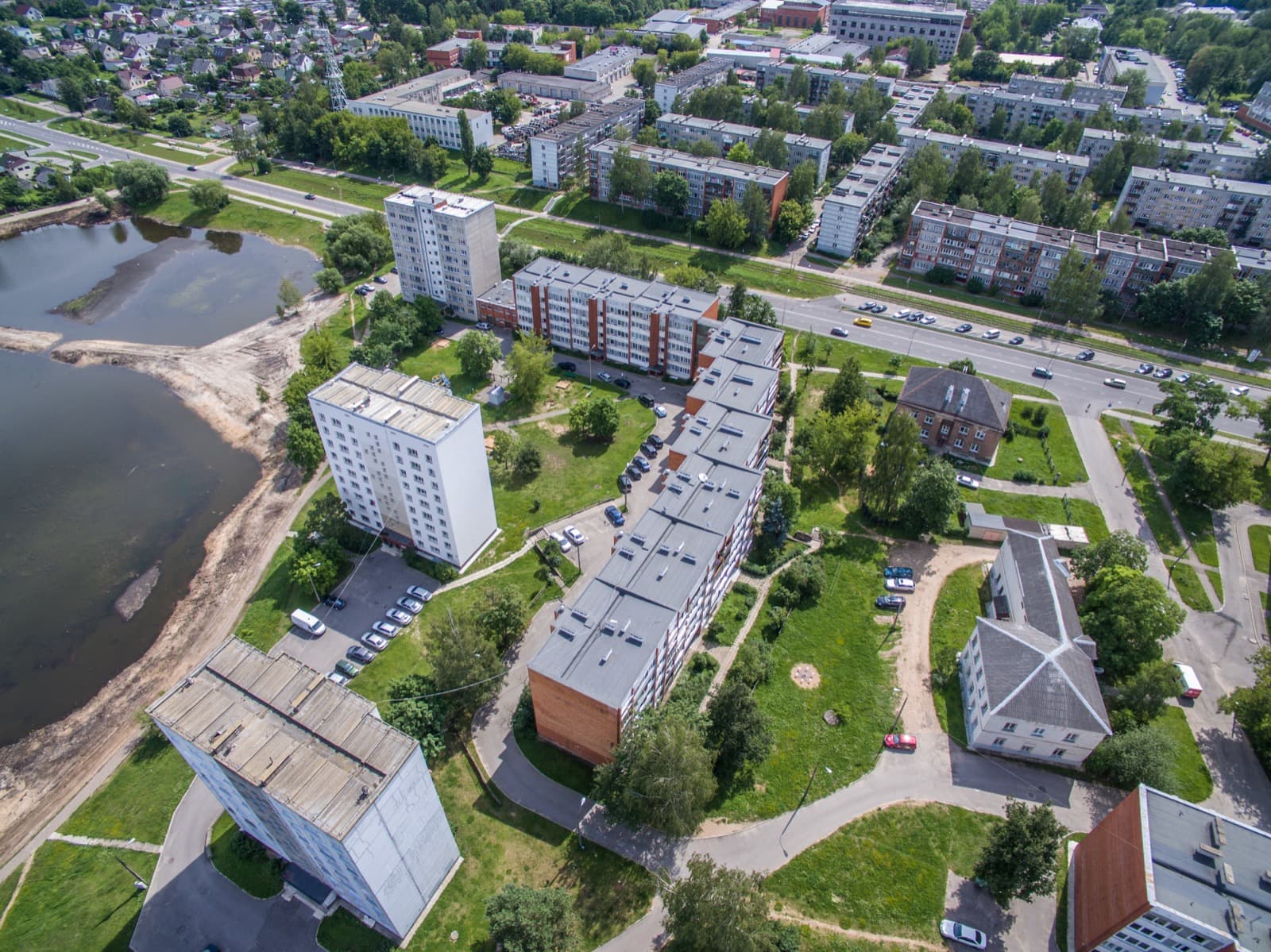
Jaunbūve, whose name means New buildings, is standard postwar and late-Soviet residential Daugavpils: mid-rise apartment blocks with green courtyards, local shops and schools between them, laid out along arteries like 18. Novembra iela. It is plainer than the red-brick centre or the fortress, functional living-space rather than a showpiece, though it borders the historic city and is an easy hop from it.
Roughly, it fills the territory between Višķu, Šaurā and Aizpilsētas streets, Lake Gubišče, the Catholic and Orthodox cemeteries and the railway. Its one landmark is the Lokomotīv stadium, described as one of the largest speedway-specific stadiums in Europe, home of the local speedway team.
This is a practical, lived-in district rather than a destination, and it is honest to say so up front.
Who lives here, and what the streets look like
Jaunbūve is ordinary residential Daugavpils, the Russian-speaking Latgale majority in the kind of block housing where most of the city lives. Around 89% of residents spoke Russian at home as of 2018, and the ethnic mix is roughly half Russian, then Poles, Belarusians and Latvians. State it plainly: daily life here runs largely in Russian, with Latvian the sole official language, and Daugavpils is more multi-ethnic than almost-wholly-Russian Narva across in Estonia.
The people are families and mixed ages, working households in mid-rise blocks. The streetscape is repetitive but green in the courtyards, with shops and schools threaded between the buildings and the centre a short ride west.
Getting around
Jaunbūve sits on the tram and bus network. Daugavpils is one of only three tram cities in Latvia, and the historic main route linked the railway station to the chemical-fibre works through this side of the city, so trams and buses reach the centre and station in minutes, a single fare 1.00 euro. The layout is flat and walkable for daily errands within the district, and a car helps for anything further.
The wider caveat is the city's: Riga Airport is about 230 km northwest, so there is no fast air link, and Vilnius Airport in Lithuania, about 185 km away, is comparable for some trips. Confirm current Riga train times before you rely on them.
Typical weekday minutes from Jaunbūve, with the icon showing how. Times via Google Routes API for a typical weekday around 08:00, measured from the neighborhood centre; the icon shows the fastest sensible way., 2026-08.
Daily life
Everyday shopping is solid. Maxima XX on Kandavas iela and a Rimi at 18. Novembra iela 136 cover groceries, with local shops in the blocks and the big Ditton Nams centre a short ride away. For food delivery, Wolt and Bolt Food both cover Daugavpils. Be honest with yourself, though: sit-down dining and cafés in Jaunbūve proper are thin, and the centre is where the restaurants are.
Local Places Worth Knowing
Independent and close by, chosen on merit. Nobody pays to appear here.
The district's anchor, described as one of Europe's larger speedway-specific stadiums and home of the local speedway team.
A large everyday supermarket on Kandavas iela serving the residential blocks, one of the district's two main grocers alongside the Rimi on 18. Novembra iela.
An everyday coffee-and-pastry spot among the blocks on the district's main street. Sit-down dining in Jaunbūve is genuinely thin and residents head to the centre.
A second local everyday café in the residential blocks, the kind of small neighborhood spot the district runs on.
Checked August 2026. Places close and change, so tell us if something here is out of date.
Schools and families
Schools sit between the blocks within walking distance, the practical setup of a family district, but Latvia publishes centralised-exam results and no usable per-school quality ranking. It is the sort of gap we would rather flag than fill, which is part of why we build these Daugavpils guides the way we do. Check the specific schools and their language of instruction before you sign a lease or purchase.
Kids Friendly. Green courtyards, sports grounds, schools and grocers all sit between the blocks within walking distance, the kind of practical block housing where much of the city raises families.
Pet Friendly. Leafy block courtyards and neighborhood parks give easy everyday dog-walking; standard Latvian lead rules apply, with less private garden than a house district.
Green space, leisure and eating out
Green space here is courtyard greens and neighborhood parks, plus sports grounds and the Lokomotīv speedway stadium, which brings a genuine local crowd on race days. The Daugava, the centre and the fortress are all a short trip west. Eating out is the honest weak spot: the district runs on grocers and a few everyday coffee stops, and residents head into the centre for a proper meal.
What it costs
Jaunbūve is the cheapest kind of stock in one of Latvia's cheapest cities, ordinary Soviet block housing at or below the city figure. Latvia publishes no official per-district figure, so we use Numbeo's crowd-sourced city numbers: about 767 EUR / m² ≈ $80 / sq ft to buy, and roughly 250 EUR / mo for a one-bedroom to rent. Both are market estimates, so confirm live listings before you commit.
Weather and climate
Seasonal averages for Daugavpils, one representative month per season. LVĢMC 1991-2020 normals (Daugavpils station) via Wikipedia climate box; a continental inland climate, colder winters and warmer summers than coastal Latvia; the climate box gives annual sunshine (~1,789 hours) and annual rain-days (~117) only, so per-season sun-hours and rain-days are not separately published.
The honest downsides
Plain, repetitive Soviet blocks. There is little architectural or destination appeal, and on-the-ground dining is thin. This is functional residential Daugavpils, chosen for price and practicality, not charm.
It shares the city's structural story. A shrinking, ageing population and the Latgale region's higher unemployment apply here as across the city, and there is no district-level crime or income breakdown to say Jaunbūve is better or worse than its neighbours.
Crime and safety
Latvia's statistics office publishes recorded crime only by municipality, so there is no standalone Jaunbūve figure; pull the exact city number from the CSP table before you rely on it. The one captured measure is Numbeo's crowd-sourced index, which reads Daugavpils as a low-crime city with very high daytime walking safety and low violent crime. Latvia as a whole has carried the EU's highest recorded homicide rate in recent years, but that is a national statistic shaped by wider social factors, not a Jaunbūve-street fact, and Latgale's status as the poorest region is best read as economics rather than street danger.
Is this you?
If you want the cheapest practical home close to the centre, are comfortable in a Russian-speaking city, and treat block housing as somewhere to live rather than somewhere to show off, Jaunbūve does the job with little fuss. If you want character, cafés and old-town texture, the centre around Rīgas iela is the place; if you want quiet and heritage on a similar budget, look at Cietoksnis inside the fortress.
Want to know what homes here are actually worth?
Join the waitlistHow we source this
How we put this together. Gathered on the ground by our local field team and written up by the Apraiz research team. Every figure above carries its own source and date. The scores are not computed by the build; walking and transport will use open map and transit data first, then Apraiz's own model. We update prices quarterly, transport and amenities twice a year, and school data when the source publishes.
Sources: onlatvia (New Daugavpils), Wikipedia, Daugavpils satiksme, Numbeo, Latvia Official Statistics (CSP).
Safety and crime in Daugavpils →Nearby: Centrs · Cietoksnis