
Long Story ShortReadHide
- What it is: Turku's compact commercial heart around Kauppatori, the market hall at one end and the riverbank bars along the Aura, with the car-free Yliopistonkatu carrying the café and shopping life.
- Who it suits: professionals, students and renters who want everything on foot and do not mind trading garden calm for a lively, built-up centre.
- What it costs: around 3 655 EUR / m² ≈ $390 / sq ft to buy, well above the Turku average.
- What people complain about: it is the busiest, hardest-surfaced part of the city, thin on private green, and the long market-square rebuild left the core feeling more transactional than homely.
First impressions
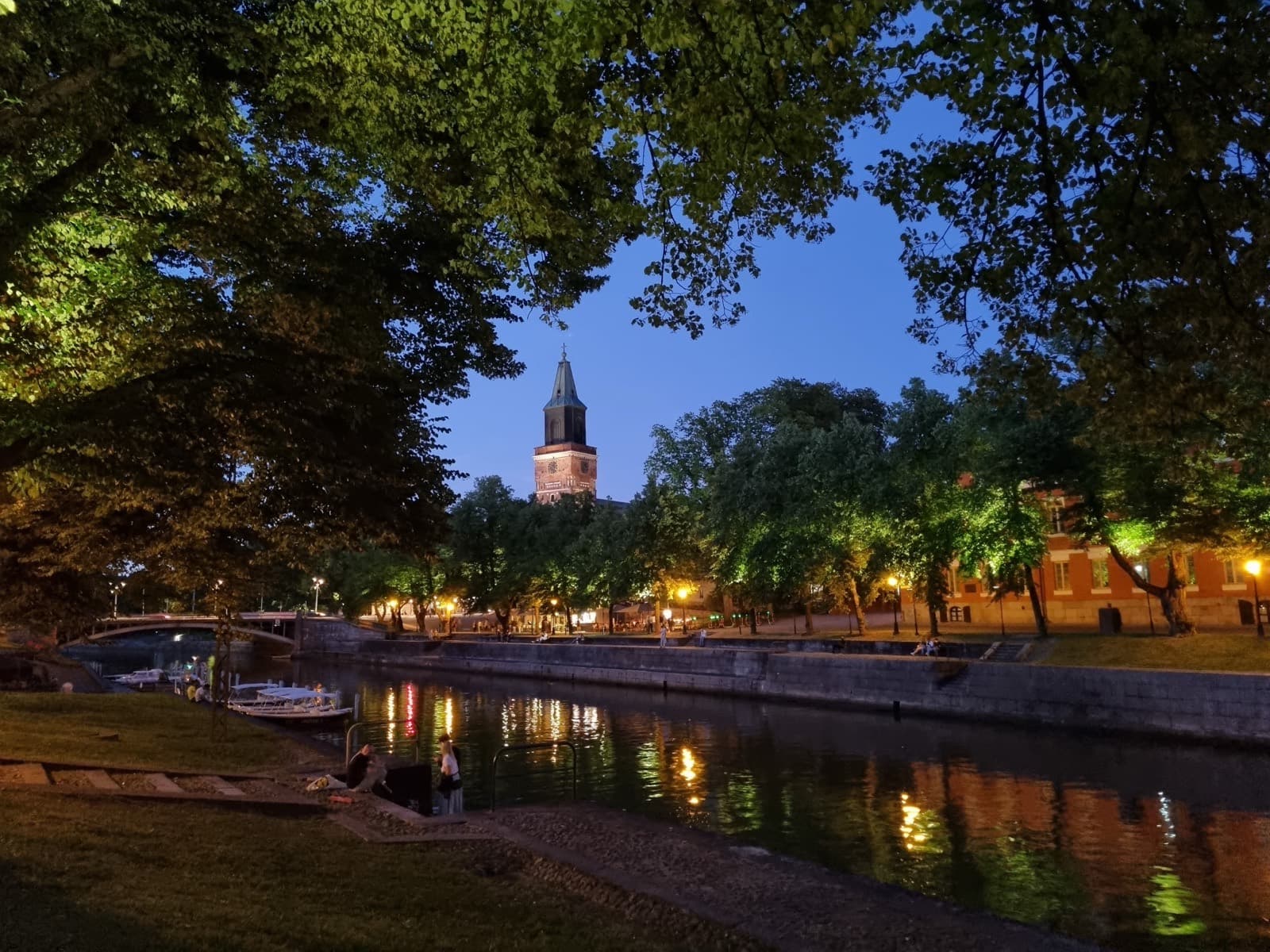
Keskusta is Turku organised around one square. The red-brick Kauppahalli sits at one end of Kauppatori, the Orthodox church at the other, and on weekday mornings the market stalls fill in between with produce, smoked fish and rye bread. Walk a block and you are on Yliopistonkatu, pedestrianised since 2001, where most of the city's cafés and shops line up. A short walk more and you are on the Aura, where the riverbank terraces come alive in summer and the long northern light stretches the evenings out.
It is a Nordic sort of centre, austere and unshowy for much of the year, then warm and busy the moment the weather turns. Groceries, the market, cafés and independent shops all sit inside a five-minute walk, and the trams and buses converge here, so this is the most connected address in Turku.
Who lives here, and what the streets look like
The centre draws professionals, students and long-term city dwellers who want to live where things happen. It is mostly apartment living in dense blocks, so it skews toward renters and smaller households rather than families with gardens.
The streetscape is stone and brick, not lawn. Blocks meet the pavement directly, the square and the market hall anchor the daily rhythm, and the river gives the one soft edge. It is handsome in a compact, worked-in way, and it is unmistakably a working city centre rather than a quiet quarter.
Getting around
This is the easiest place in Turku to live without a car. Trams and buses meet on and around the market square, the railway station is a short walk or one stop away, and the harbour with its Stockholm and Mariehamn ferries is a straightforward run to the west. Cycling is flat and quick, and most daily errands are simply on foot.
Typical weekday minutes from Keskusta, with the icon showing how. Times via Google Routes API for a typical weekday around 08:00, measured from the neighborhood centre; the icon shows the fastest sensible way., 2026-08.
Daily life
Everyday shopping barely needs planning here. The Kauppahalli covers delis, fish and specialist counters, the weekday market square handles produce, and full-size grocers sit within a couple of minutes in every direction. That density is the centre's real luxury: you can shop small and often, the European way, rather than driving to one big weekly run. For food delivery, Wolt and Foodora both cover Turku.
Local Places Worth Knowing
Independent and close by, chosen on merit. Nobody pays to appear here.
Finland's second-oldest market hall, opened 1896, with fish and meat counters, delis and cafés under one roof on Eerikinkatu.
An independent art café on the Aura riverbank whose baristas have repeatedly placed in Finland's Barista of the Year.
Independent Finnish design, textiles, wooden jewellery and homeware, a block from the market square on Kristiinankatu.
View on Google MapsAn independent modern-Nordic restaurant on the central riverbank, with a seasonal menu that leans on Baltic herring and local produce.
Checked August 2026. Places close and change, so tell us if something here is out of date.
Schools and families
Central catchment schools serve Keskusta, and Finland gives families broadly free school choice rather than tying you to one address. Finland publishes no per-school ranking, a deliberate national policy. It is the kind of gap we would rather flag than fill, which is part of why we build these Turku guides the way we do. Check the specific schools and their admission before you sign a lease or purchase.
Kids Restricted. The market and riverbank are pleasant, but heavy traffic, an open river edge and little on-block play space make it a better fit for adults than young families.
Pet Restricted. The river walk and small central parks like Puolalanpuisto give a dog somewhere to go, but the core is dense, hard-surfaced and busy with trams and traffic.
Green space, leisure and eating out
Green space is the centre's weak point. The river walk and small parks like Puolalanpuisto are the main outdoor rooms, and for anything larger you head to Samppalinna or Kupittaa Park a short way out. What the centre offers instead is culture and eating out: the cathedral and the museums are minutes away, and the independent restaurants and cafés, from the riverbank fine dining at Smör to the market-hall counters, are concentrated enough that you are never short of an option.
What it costs
Buying in the centre runs about 3 655 EUR / m² ≈ $390 / sq ft for old flats in housing companies, well above the roughly 2,900 per square metre Turku average, with the riverside blocks dearer still. Finland publishes rent as a price per square metre rather than a monthly headline, so we show an indicative 740 EUR / mo for a typical two-room flat, derived from the central postal-area figure. Furnished short lets in the core run higher.
Weather and climate
Seasonal averages for Turku, one representative month per season. FMI 1991-2020 normals (Turku Airport) via Wikipedia climate box; among Finland's warmest summers.
The honest downsides
It is dense, hard and busy. This is the least green corner of Turku, with traffic, trams and market and nightlife noise, and very little private outdoor space of your own.
The core still feels transactional. The 2020 to 2022 market-square rebuild was a long, disruptive project, and even finished, the centre reads more as a place you pass through and shop in than a settled residential quarter.
Crime and safety
Turku records a little more crime than Finland's smaller towns, which fits a regional hub with a dense centre, a big student and nightlife population and a busy port, and the mix is dominated by theft rather than violence. Finland publishes crime only by municipality, so there is no standalone Keskusta figure against the city rate. Reporting trust is high in Finland, so the recorded numbers track real incidence closely. The centre feels its busiest, and its most opportunistic for pickpocketing, on market days and weekend nights.
Is this you?
If you want to live on foot, with the market, the river and the trams at your door, Keskusta is Turku at its most convenient. If you want quiet, green and space for the money, Portsa, Hirvensalo or the northern suburbs will suit you far better.
Want to know what homes here are actually worth?
Join the waitlistHow we source this
How we put this together. Gathered on the ground by our local field team and written up by the Apraiz research team. Every figure above carries its own source and date. The scores are not computed by the build; walking and transport will use open map and transit data first, then Apraiz's own model. We update prices quarterly, transport and amenities twice a year, and school data when the source publishes.
Sources: Statistics Finland (Tilastokeskus) / asuntojenhinnat.fi, Statistics Finland (Tilastokeskus), Rents of dwellings, Statistics Finland (Tilastokeskus), Wikipedia.
Safety and crime in Turku →Nearby: Port Arthur · Martti · Kupittaa