
Long Story ShortReadHide
- What it is: a central quarter just west of the centre, a former working-class wooden-house district rebuilt in the 1960s and 1970s into a dense, well-serviced residential area, keeping one preserved wooden block as a museum.
- Who it suits: young professionals, students and older residents who want a very central, walkable address with culture on the doorstep and can do without a garden.
- What it costs: well above the city average, about 3 810 EUR / m² ≈ $410 / sq ft to buy.
- What people complain about: the historic wooden Amuri is essentially gone, so you get a fairly ordinary mid-century townscape with little private green, at central prices.
First impressions
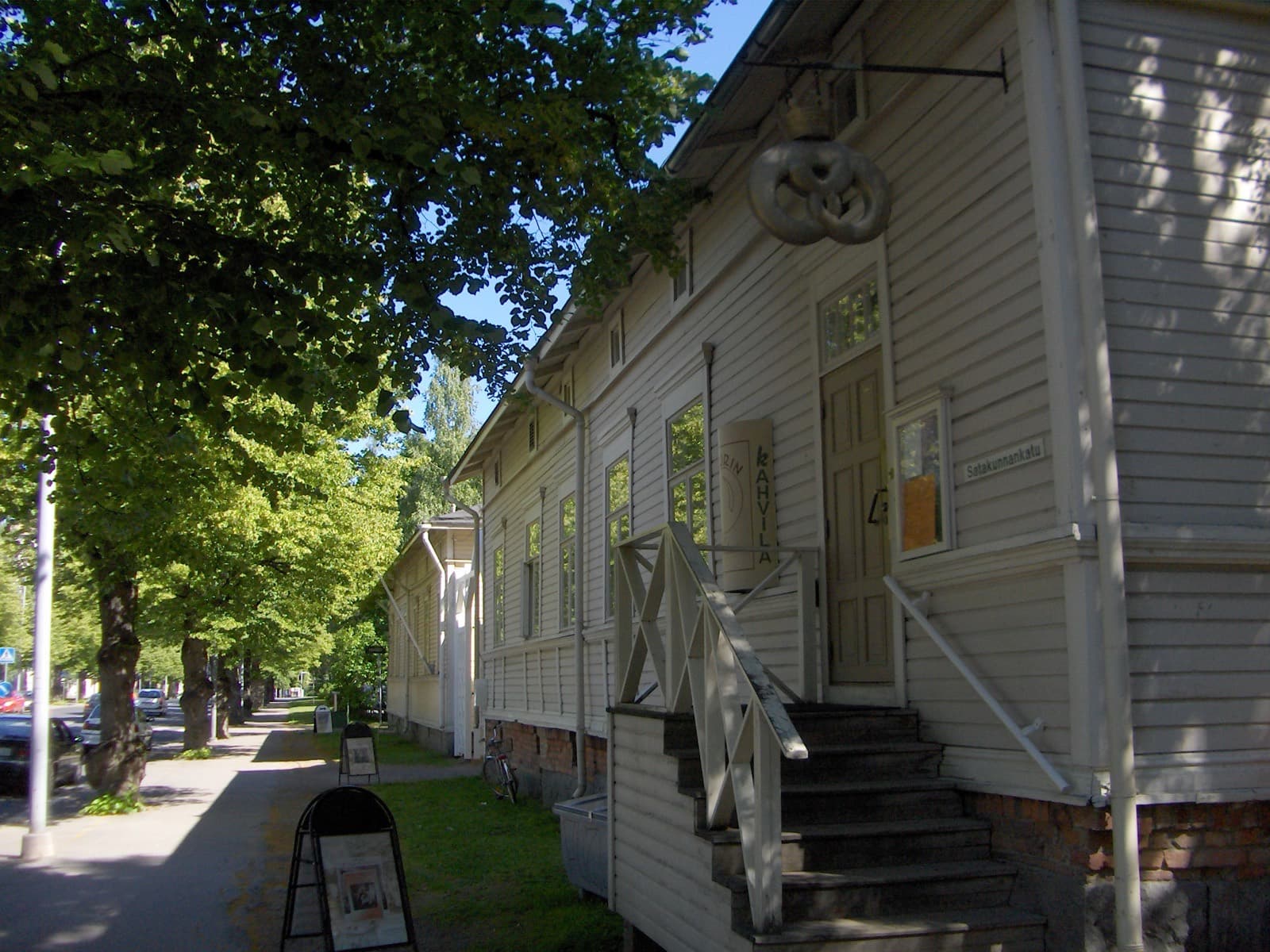
Amuri sits just west of the centre, between the Hämeenpuisto esplanade and the lake, south of the Särkänniemi headland. It was built from the 1860s as a working-class wooden-house quarter, famous for its shared communal kitchens, but the old wooden blocks were demolished in the 1960s and 1970s and replaced with low-to-mid-rise apartment buildings. Today it is a dense, central, well-serviced residential area of about 5,500 people, keeping one preserved wooden block as an open-air museum and holding the Tampere Art Museum and the Metso main library.
The honest caveat is that the historic Amuri is largely a memory: outside the museum block, residents get a fairly ordinary mid-century apartment townscape with little private green, and they pay central-Tampere prices for the position.
Who lives here, and what the streets look like
Amuri draws young professionals, students, a broad mix of ages and long-settled older residents, the kind of population a central, rental-friendly district collects. It is unpretentious and lived-in.
The streetscape is mostly 1960s and 1970s apartment blocks on a regular grid, with the preserved wooden museum block, the art museum and the library as the standout exceptions. It is central and convenient rather than pretty, with the greenery borrowed from Väinö Linnan puisto and the Hämeenpuisto esplanade rather than found between the blocks.
Getting around
Amuri's strength is that you barely need transport. The centre, its trams and the station are a short walk east, buses run along the bounding streets, and the flat, central position makes walking and cycling the natural way to move. The Tampere tram, which opened in August 2021, is reached in the centre a few minutes away rather than on Amuri's own streets.
Typical weekday minutes from Amuri, with the icon showing how. Times via Google Routes API for a typical weekday around 08:00, measured from the neighborhood centre; the icon shows the fastest sensible way., 2026-08.
Daily life
Everyday shopping is easy from Amuri: central grocers and small shops are close, and the full run of the centre's stores is a short walk east, so daily errands rarely mean travelling. Its genuine café and shopping life runs along the Hämeenpuisto and centre edge rather than deep inside the blocks. For food delivery, Wolt and Foodora both cover Tampere.
Local Places Worth Knowing
Independent and close by, chosen on merit. Nobody pays to appear here.
An open-air museum on Satakunnankatu of five original dwelling houses and four courtyard buildings, furnished from 1882 to 1973, with a period sauna, bakery and shops.
A traditional independent café in an old wooden building beside the museum, with its own bakery, porridge and old-fashioned lemonade.
A long-running independent Belgian-beer gastropub on Amuri's eastern edge at Hämeenpuisto.
A friendly independent neighborhood pub on Satakunnankatu, with weekly trivia, bingo and billiards.
Checked August 2026. Places close and change, so tell us if something here is out of date.
Schools and families
Amuri draws on central-Tampere comprehensive schools, and Finland gives families broadly free school choice rather than tying you to one catchment. Finland publishes no per-school ranking, a deliberate national policy. It is the sort of gap we would rather flag than fill, which is part of why we build these Tampere guides the way we do. Check the specific schools and their admission before you sign a lease or purchase.
Kids Restricted. Very central with schools, the library, the art museum, a swimming hall and the workers' museum all walkable, but an apartment-block area with busy bounding streets and no large in-district playground green.
Pet Restricted. Central and dense with little private green, but Väinö Linnan puisto, the Hämeenpuisto esplanade and the nearby lakeshore and Pyynikki ridge are a short stroll.
Green space, leisure and eating out
Green space in Amuri is borrowed rather than built in: Väinö Linnan puisto, the Hämeenpuisto esplanade and the nearby lakeshore and Pyynikki ridge give places to walk a short stroll away. What the district does have in depth is culture, with the Tampere Art Museum, the Metso library and the workers' housing museum all here, and eating out that leans on genuine independents like the Amurin Helmi café and the Tuulensuu gastropub along the Hämeenpuisto edge.
What it costs
Amuri carries a clear premium for its walkable, central, lake-adjacent position. A realised-sale index for the 33230 area puts flats at about 3 810 EUR / m² ≈ $410 / sq ft, well above the city average, though this is a commercial figure whose basis differs from the official Statistics Finland series, so the exact per-area figure should be pulled at publish. Finland does not publish a per-district monthly rent, so we show the Tampere city 2-room average of about 850 EUR / mo as a guide; central Amuri sits at the upper end in practice.
Weather and climate
Seasonal averages for Tampere, one representative month per season. FMI 1991-2020 normals (Tampere-Harmala) via Wikipedia climate box; sunshine hours not published.
The honest downsides
The old Amuri is gone. The wooden quarter that gave the district its character was bulldozed in the 1960s and 1970s, so outside the museum block you get a fairly ordinary mid-century apartment townscape.
You pay central prices for little green. Amuri is dense and central, so private outdoor space is scarce and the price sits well above the city average, which is the trade-off for the walkable position.
Crime and safety
Amuri is a central, lived-in residential quarter and is safe by any European measure, sharing the centre's ordinary petty-theft profile rather than anything worse. Finland publishes crime only at the city and municipality level, so there is no standalone Amuri figure. Tampere is a calm inland city, and high police-reporting trust means the city-wide numbers track real incidence closely. The fuller Tampere picture is on the city safety page.
Is this you?
If you want a very central, walkable address with culture on the doorstep and no need for a car, Amuri delivers it, so long as you do not need a garden. If you want space and green for the money, Kaleva or a lakeside district like Lentävänniemi will give you far more.
Want to know what homes here are actually worth?
Join the waitlistHow we source this
How we put this together. Gathered on the ground by our local field team and written up by the Apraiz research team. Every figure above carries its own source and date. The scores are not computed by the build; walking and transport will use open map and transit data first, then Apraiz's own model. We update prices quarterly, transport and amenities twice a year, and school data when the source publishes.
Sources: Kiinteistömaailma / asuntojenmyynti; reconcile with Statistics Finland (Tilastokeskus), Statistics Finland (Tilastokeskus), Rents of dwellings, Wikipedia, Tilastokeskus.
Safety and crime in Tampere →