
Long Story ShortReadHide
- What it is: a large early-20th-century wooden district south of the centre, famous for its Art Nouveau timber houses, a lively arts scene on Tähe street and the Aparaaditehas creative city.
- Who it suits: young families, artists and creatives who want wooden-house charm, community life and a short hop to the centre.
- What it costs: around 2 150 EUR / m² ≈ $230 / sq ft to buy, at or just below the city average.
- What people complain about: uneven renovation across the wooden stock and tight parking, plus real traffic on the through-streets Tähe and Võru.
First impressions
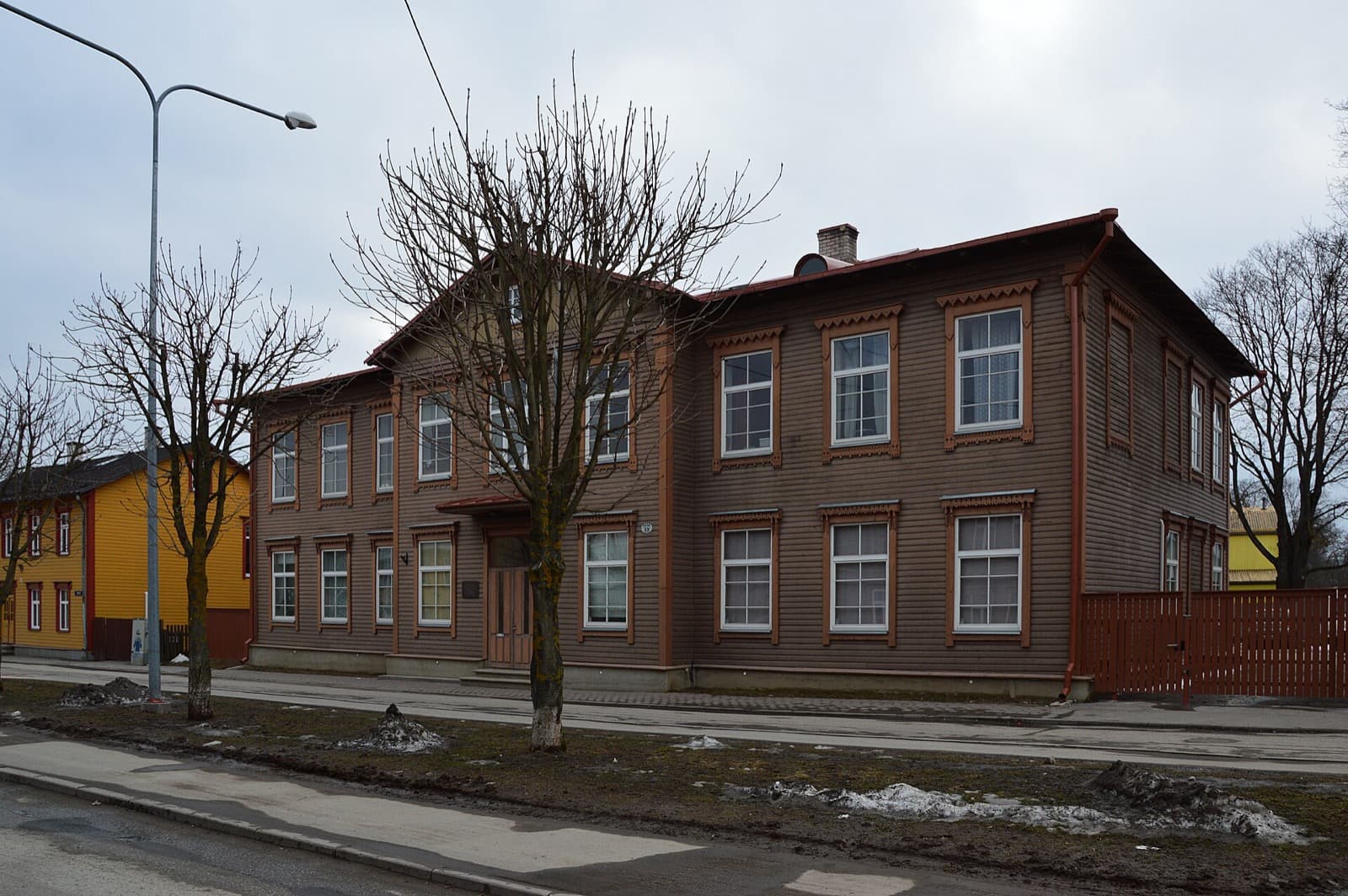
Karlova is Tartu's arty wooden quarter. Streets of ornate two-storey timber houses run south from the centre, their facades carved, their backyards fitted with the district's characteristic two-storey sheds. Tähe street threads through the middle with cafés, bars, studios and small shops, and the converted Aparaaditehas factory yard anchors the creative scene on the edge.
It is a large district, around 8,900 people over 2.3 square kilometres, roughly a tenth of the city, and it has a strong sense of itself: an active Karlova Society, community days every year since 2010 and an annual festival. It has been a home to writers and painters for a century and still draws artists and young families.
The honest caveat is that a wooden district ages unevenly. Some streets are beautifully restored, others still wait their turn.
Who lives here, and what the streets look like
Karlova draws young families, artists, cultural figures and students, the mix that gives it its up-and-coming reputation. It has a long creative lineage, from writers like Anna Haava to painters like Elmar Kits, and that identity still shapes the place.
The streetscape is low, leafy and wooden: two-storey houses with gardens, quiet residential lanes, and the busier commercial spine along Tähe. It is flat and very bike-friendly, and a walk of 10 to 15 minutes, or a short ride, reaches the centre.
Getting around
Karlova sits on good bus lines along Tähe and Võru, so the centre and the wider city are an easy ride, though as an inner suburb it is served rather than a hub, which is why the transit score is solid but not top. Most residents cycle: it is flat, the grid is walkable, and Tartu's biogas buses run frequently on the main streets.
Typical weekday minutes from Karlova, with the icon showing how. Times via Google Routes API for a typical weekday around 08:00, measured from the neighborhood centre; the icon shows the fastest sensible way., 2026-08.
Daily life
Everyday shopping is decent and getting better. Tähe street has independents, cafés and bars, there is a Wolt Market Karlova grocery, and supermarkets sit nearby, while Aparaaditehas adds eateries and design shops. For food delivery, Wolt and Bolt Food both cover Tartu in full, and Wolt runs a Wolt Market in the district itself, so groceries can come to the door.
Local Places Worth Knowing
Independent and close by, chosen on merit. Nobody pays to appear here.
A bakery-café in the Aparaaditehas creative city, known for croissants and pastries.
An Italian-run community bar-restaurant on Tähe with craft beer, Italian wine and pizza, credited with reviving the street since 2015.
A world-street-food restaurant with an open kitchen inside Aparaaditehas.
View on Google MapsAn old factory turned arts-and-food complex with the TYPA printing-arts centre, host to the Aparaaditehas festival and gallery nights.
View on Google MapsChecked August 2026. Places close and change, so tell us if something here is out of date.
Schools and families
Karlova is a genuine young-family district, and Estonia gives families broad school choice rather than tying you to one catchment. Estonia publishes no per-school quality ranking. It is the sort of gap we would rather flag than fill, which is part of why we build these Tartu guides the way we do. Check the specific schools and their admission before you sign a lease or purchase.
Kids Friendly. A well-established young-family district: quiet wooden streets, gardens, community days and the Karlova festival, with the centre a short walk or ride away.
Pet Friendly. Leafy low-rise streets, gardens and the nearby river and Ropka meadows make dog-walking easy across the district.
Green space, leisure and eating out
Green space comes from the district's own gardens and leafy streets, with the river and the Ropka meadows along the southern edge. Leisure centres on Aparaaditehas, which hosts festivals, gallery nights, concerts and workshops around the TYPA printing-arts centre. Eating out is a real strength for an inner suburb: Barlova revived Tähe street, Kolm Tilli and other spots fill the old factory, and the cafés and bars give the area its evening life.
What it costs
Karlova buys at or just below the city average. Market reviews put it with Supilinn at about 2 150 EUR / m² ≈ $230 / sq ft (Arcovara via Tartu Postimees, 2024, €2,000-2,300), against a Tartu city average of roughly €2,443/m², with popularity and gentrification pushing figures up. Estonia publishes no per-district monthly rent, so we show the Tartu city estimate of around 700 EUR / mo for a 2-bed as a guide (Expat Focus aggregator, €650-750).
Weather and climate
Seasonal averages for Tartu, one representative month per season. Estonian Weather Service (Riigi Ilmateenistus) 1991-2020 normals (Tartu-Tõravere) via Wikipedia climate box.
The honest downsides
The wooden stock is uneven. Renovation and insulation vary widely from street to street, some houses still await upgrades, and parking is tight across the district. A charming facade can hide a project.
The through-streets carry traffic. Tähe and Võru are real routes, not quiet lanes, so a flat on them is livelier and noisier than the leafy interior. Gentrification has also pushed prices up from where they were.
Crime and safety
Tartu reads as a calm university city, and Karlova is a settled residential district within it. Estonia publishes registered crime only at county level, so there is no Tartu-city or per-district figure: the finest number available is for Tartu county, about 2,480 registered crimes per 100,000 residents in 2024, the 3rd-highest county rate in Estonia and above the national average of 2,060. That covers the whole county, not this district, and no county violent-crime rate is published.
Is this you?
If you want wooden-house charm, an arts scene on the doorstep and a real community, with the centre a short ride away, Karlova is one of the most likeable addresses in Tartu. If you want the same timber character but even quieter and more village-like, and can accept fewer shops, Supilinn on the other side of the centre will suit you.
Want to know what homes here are actually worth?
Join the waitlistHow we source this
How we put this together. Gathered on the ground by our local field team and written up by the Apraiz research team. Every figure above carries its own source and date. The scores are not computed by the build; walking and transport will use open map and transit data first, then Apraiz's own model. We update prices quarterly, transport and amenities twice a year, and school data when the source publishes.
Sources: Wikipedia, Visit Estonia, Tartu Postimees (Arcovara market review), Justiits- ja Digiministeerium, Expat Focus (aggregator estimate).
Safety and crime in Tartu →