
Long Story ShortReadHide
- What it is: Kristiansand's Renaissance grid city centre between the river and the sea, with the white-wooden old town of Posebyen and the Fiskebrygga harbour.
- Who it suits: couples and professionals who want to live in the middle of the city, walk everywhere, and do not mind summer visitors.
- What it costs: central and historic, above the low city average; no separate figure is published, so we show the Kristiansand average of about 47,000 kr per m².
- What people complain about: summer crowds and nightlife noise, and little green or family infrastructure inside the grid.
First impressions
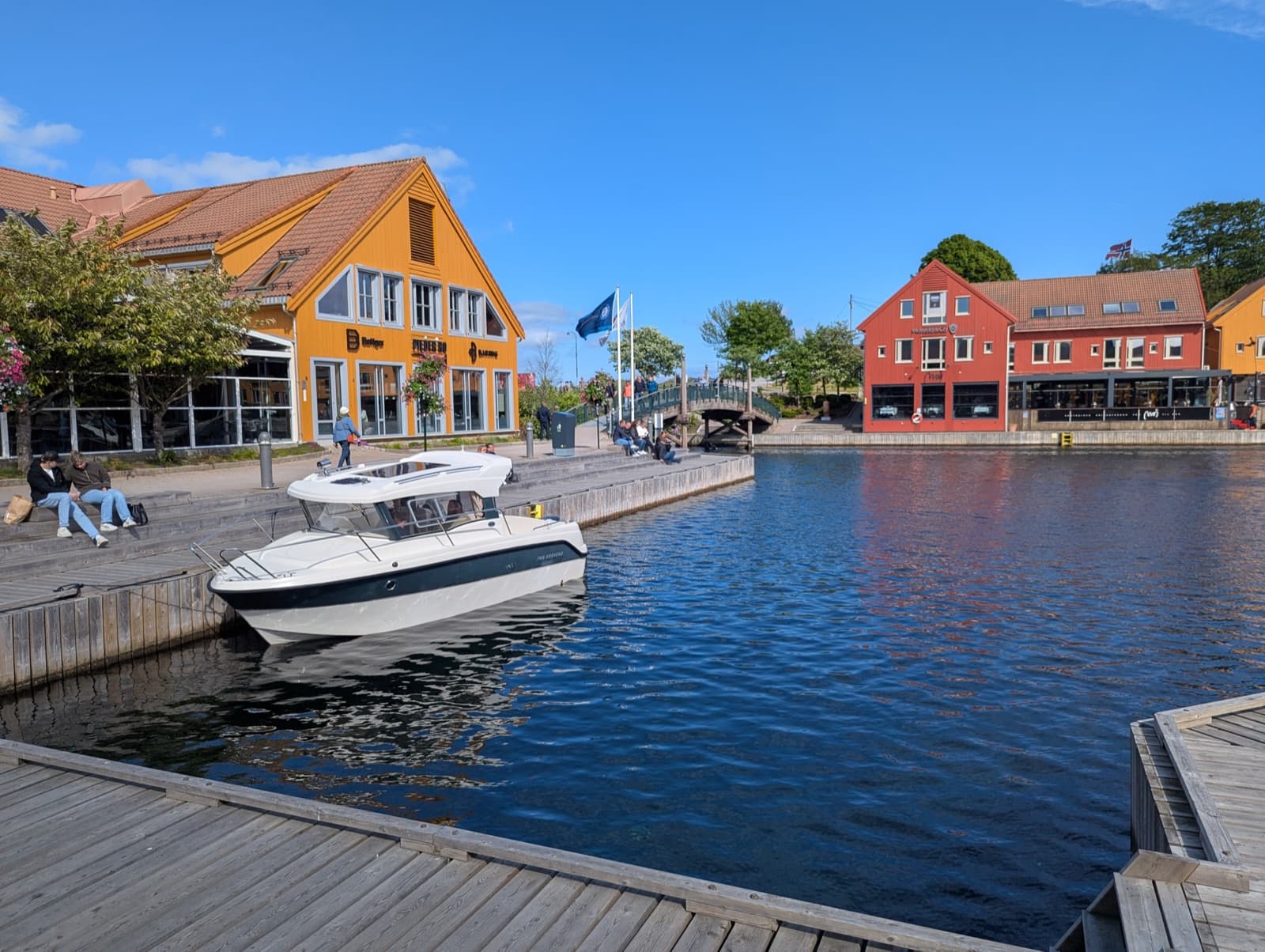
Kvadraturen is Kristiansand itself, the Renaissance grid King Christian IV laid out in 1641 on the flat between the Otra river and the sea. It is a compact chequerboard of low streets, with the pedestrian shopping run of Markens gate down the middle, the white-wooden old town of Posebyen at one corner, and the Fiskebrygga fish market and canals on the harbour. Christiansholm fortress guards the water.
It is historic, central and by the sea, walkable and lively, the region's shopping, ferry and summer-nightlife heart.
This is the middle of the city, and it lives at a walking pace with a summer crowd.
Who lives here, and what the streets look like
Kvadraturen is a mixed, mostly adult centre, young professionals and a broad age range in the flats above the shops, rather than a family enclave; the family housing and school catchments are in the surrounding boroughs. It is a place people live in the middle of things.
The streetscape is the grid: flat, regular streets, the pedestrian Markens gate, the wooden cottages of Posebyen, and the canals and boathouses of Fiskebrygga on the water. It is easy to walk and busy in season.
Getting around
Kvadraturen is a walking centre with the region's transport hub at its edge. The bus terminal, train station and ferry quay cluster together at the southern edge of the grid, so the AKT buses, the Sørlandsbanen railway and the Color Line ferry to Denmark are all at hand, and the grid itself is five to ten minutes on foot end to end. Kjevik airport is about twenty minutes out.
Typical weekday minutes from Kristiansand stasjon, with the icon showing how. Times via Google Routes API for a typical weekday around 08:00, measured from the neighborhood centre; the icon shows the fastest sensible way (walk, bike, transit or car)., 2026-08.
Daily life
Day to day, Kvadraturen is Markens gate and the harbour. The central grid leans to smaller-format grocers, with a Bunnpris and Kiwi and a Meny near the centre, and the shopping is the pedestrian Markens gate, "usually bustling", plus the independent shops in Posebyen's white wooden houses. For food delivery, Foodora and Wolt both cover Kristiansand.
Local Places Worth Knowing
Independent and close by, chosen on merit. Nobody pays to appear here. Links are being confirmed.
A waterfront seafood house on Østre Strandgate, with seasonal Norwegian cooking across three rooms.
View on Google MapsAn 'urban bondekost' farm-to-table café on Øvre torv in the heart of the grid.
View on Google MapsSørlandet's flagship performing-arts centre on the harbour, home of the Kristiansand Symphony Orchestra.
View on Google MapsThe harbourside fish market and quay on the Gravanekanalen, mustard-and-red boathouse buildings around four canal bridges, with a fish market and restaurants.
Checked August 2026. Places close and change, so tell us if something here is out of date.
Schools and families
Kvadraturen is a central quarter rather than a family suburb, and the schools sit in the surrounding boroughs. The nearest lower-secondary is Oddemarka skole across the Otra in Lund, and there is no primary school inside the grid, so families rely on the schools uphill and across the river. Norway publishes school results through Udir, but not at a per-district grain, so we do not rate schools here. Kristiansand has free school choice, so it is worth checking admission before you sign a lease or purchase.
Kids Restricted. Walkable and flat with the Fiskebrygga canals and harbour to explore, but the region's busy commercial and nightlife core, so it suits couples and professionals more than young children; family housing and schools sit in the surrounding boroughs, with big green play up at Baneheia.
Pet Restricted. A dense historic grid with pedestrian shopping streets and harbour promenades pleasant for a walk, but limited private garden space; the bigger green of Baneheia and Ravnedalen is a short walk uphill just outside the grid.
Green space, leisure and eating out
Kvadraturen's outdoors is the harbour and the parks uphill. The Fiskebrygga quay and the Gravanekanalen canals are the social waterfront, Posebyen is the wooden old town, and Christiansholm fortress is a summer cultural venue, while the Ravnedalen nature park and the Baneheia woods and lakes are a short walk uphill just outside the grid. Kilden performing-arts centre sits on the harbour, and eating out clusters on the quay and along Markens gate.
What it costs
Kvadraturen is the central, historic quarter, so it prices above the low city average. No Kvadraturen-specific sale price is published, so we show the Kristiansand city average of about 47 126 NOK / m² (about €4,300 / m²) ≈ $460 / sq ft (Krogsveen, second quarter of 2026), and the centre sits above it. Rent is set by the market rather than any first-hand system, and Norway does not publish a Kristiansand-specific figure, so we show the wider size-band average of around 9 880 NOK / mo (about €900 / mo) (SSB, 2025) as a guide.
Weather and climate
Seasonal averages for Kristiansand, one representative month per season. MET Norway 1991-2020 normals (Kristiansand-Kjevik) via Wikipedia climate box.
The honest downsides
Tourist and nightlife load in season. As Sørlandet's main summer destination and the centre's bar and restaurant core, Kvadraturen gets crowded and can be noisy at night, especially around Markens gate and the harbour.
Little in-grid green or family infrastructure. The dense historic grid has scarce private gardens and no primary school inside it, so families rely on green space and schools uphill or across the Otra; it suits couples and professionals more than young children.
Crime and safety
As the region's concentrated centre for shopping, ferries and summer nightlife, Kvadraturen naturally sees a higher share of the city's reported incidents, typical of a busy regional hub in peak season, rather than reflecting a uniquely unsafe neighborhood, and Norway does not publish neighborhood-level crime figures, so there is no local number. Like most Norwegian city centres, there is a small amount of visible rough sleeping or begging around the main squares and station, and the city mission runs a café and services at Fiskebrygga. The fuller Kristiansand picture is on the city safety page.
Is this you?
If you want to live in the middle of Kristiansand, on a flat grid with the shopping street, the fish market and the ferry all at hand, and you take the summer crowds as part of the deal, Kvadraturen is the heart of the city. If you want a garden, quiet and a school at the corner, the surrounding boroughs will suit you better.
Want to know what homes here are actually worth?
Join the waitlistHow we source this
How we put this together. Gathered on the ground by our local field team and written up by the Apraiz research team. Every figure above carries its own source and date. The scores are not computed by the build; walking and transport will use open map and transit data first, then Apraiz's own model. We update prices quarterly, transport and amenities twice a year, and school data when the source publishes.
Sources: Krogsveen prisstatistikk, Statistics Norway (SSB), Leiemarkedsundersøkelsen, Wikipedia, Statistics Norway (SSB), table 08487.
Safety and crime in Kristiansand →