
Long Story ShortReadHide
- What it is: the heart of Lithuania's main seaside resort, the pedestrian J. Basanavičiaus street running down to the wooden pier and the beach, with the town's cafes, amber stalls and fairground rides, and the Tiškevičiai Palace and its Amber Museum in the botanical park just south.
- Who it suits: people who want to live on foot by the sea and can embrace an extreme seasonal swing, packed in summer and near-empty in winter.
- What it costs: a resort premium above the roughly 1 100 EUR / m² ≈ $120 / sq ft Klaipėda index, with Palanga's own per-m² not published and the seafront the dearest end.
- What people complain about: how dead and shuttered it goes out of season, and how crowded and pricey it gets in July and August.
First impressions
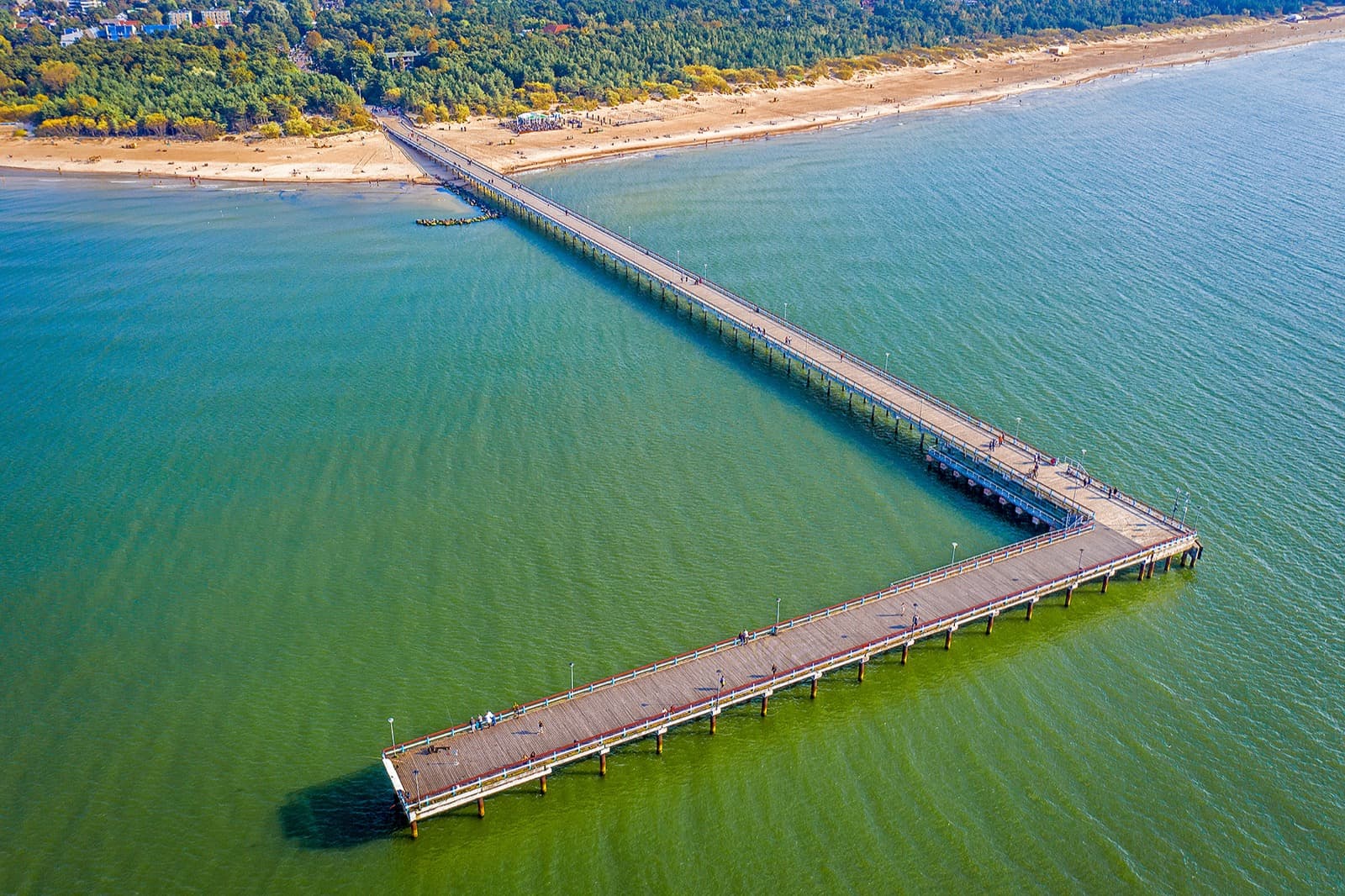
Palanga's centre is low-rise and intensely seasonal. In summer J. Basanavičiaus street is a car-free promenade thick with holidaymakers, ice-cream and amber kiosks, buskers and fairground attractions, ending at the pier where crowds walk out over the Baltic at sunset. Behind the strip the town is quiet, wooden villas and small hotels under pines.
Out of season the same street is near-empty and many businesses shut. That contrast is the honest core of the place: this is a resort first, a town second, and it lives for roughly June to August.
Who lives here, and what the streets look like
The seasonal swing is extreme. A modest year-round population of townspeople, hospitality and municipal workers and retirees is swamped each July and August by tens of thousands of Lithuanian and foreign visitors, and many central flats are holiday lets or second homes rather than permanent residences.
The streetscape is the pedestrian strip and its side lanes: wooden resort villas, small hotels and cafes under pines, opening onto the dunes, the beach and the pier at the western end.
Getting around
The centre is very walkable in summer, with the whole core and the beach a few minutes on foot, and cycling is easy on the flat resort grid. A car is normal for anything beyond town. There is no railway in Palanga: the nearest station is Kretinga, about 12 km east, and Klaipėda is about 30 km south. The airport is about 6 km north, close but seasonal in its route network.
Typical weekday minutes from Centras, with the icon showing how. Times via Google Routes API for a typical weekday around 08:00, measured from the neighborhood centre; the icon shows the fastest sensible way., 2026-08.
Daily life
Central supermarkets of the national chains (Maxima, Iki, Norfa, plus Lidl and Rimi) cover everyday groceries, alongside the Palanga market and, in summer, the street stalls. For food delivery, Wolt and Bolt Food both deliver here, with a small and seasonal selection of venues concentrated near the centre, far larger in July and August than in winter. Be honest about the off-season: choice narrows sharply once the crowds leave.
Local Places Worth Knowing
Independent and close by, chosen on merit. Nobody pays to appear here.
The roughly 470 m wooden pier over the Baltic at the west end of J. Basanavičiaus street, the resort's defining promenade and sunset spot since 1892.
A long-standing restaurant and bar on the pedestrian J. Basanavičiaus strip, named for the year, a well-known central table.
A café and restaurant in a historic wooden resort villa a short walk off the strip on S. Nėries street, calmer than the promenade.
The town's produce and goods market on Vytauto street, for fresh food, summer berries and amber and craft stalls.
Checked August 2026. Places close and change, so tell us if something here is out of date.
Schools and families
Palanga's schools serve a small year-round community, and families choose among them rather than being tied to one strict catchment. Lithuania does publish per-school state-matura (brandos egzaminai) results, so a fair ranking is possible in a later pass, but we would rather flag that gap than post a number we have not scored yet. That honesty is part of why we build these Palanga guides the way we do. Check the specific schools and their admission before you sign a lease or purchase.
Kids Friendly. A compact, flat, largely car-free resort core with the beach, pier, botanical park and fairground attractions all within a short walk, at its liveliest in summer and very quiet off-season.
Pet Restricted. The long beach, the pier promenade and the botanical park give abundant dog-walking, but Lithuanian resort beaches typically restrict dogs on the main bathing sections in high summer, steering them to designated or off-season stretches. Confirm the current Palanga beach dog rules and season before you rely on a spot.
Green space, leisure and eating out
The beach and the pier are the centre's front garden, and just south lies the large Palanga Botanical Park (Birutė Park) around the Tiškevičiai Palace, with Birutė Hill and its chapel. J. Basanavičiaus street itself is the open-air entertainment spine in summer, lined with cafes, bars and amber galleries. Eating out is dense and lively in season, from 1925 Baras on the strip to the historic Vila Ramybė just off it, and much quieter the rest of the year.
What it costs
Palanga trades at a resort premium. The nearest sourced number is the Klaipėda apartment index at about 1 100 EUR / m² ≈ $120 / sq ft (Ober-Haus, June 2026), and Palanga's own per-m² is not published but sits well above it, with the central and seafront stock the dearest in town. For rent, the market is dominated by short-term holiday lets that spike in summer, so we show the nearest-city guide of about 520 EUR / mo (Numbeo, Klaipėda) only as a rough floor; a year-round long lease in central Palanga is scarce and priced above it.
Weather and climate
Seasonal averages for Palanga, one representative month per season. LHMT (Lithuanian Hydrometeorological Service) 1991-2020 normals (shared coastal normal, Klaipėda station, ~25 km south on the same Baltic shore) via Wikipedia climate box; no separate long-run Palanga normal is published.
The honest downsides
Dead and shuttered out of season. The centre lives for roughly June to August. From autumn to spring much of J. Basanavičiaus street closes, restaurants and hotels cut their hours, and the town is very quiet.
Peak-season crowding and prices. In July and August the same streets are packed, parking is hard, nightlife noise rises, and prices for food, lodging and rentals climb well above the off-season and above inland Lithuania.
Crime and safety
Palanga is a small resort in a low-violence country, and it feels safe, though recorded incidents rise with the summer crowds, mostly petty theft and nightlife disturbance on the strip in July and August, and fall away out of season. Lithuania publishes registered crime only nationally and by county and municipality, so there is no standalone Centras figure. For national context, intentional homicides run at about 2.7 per 100,000 (UNODC, 2024). The fuller Palanga picture is on the city safety page.
Is this you?
If you want to live on foot by the sea, love the summer buzz and can accept the winter quiet, central Palanga is the resort at its most alive. If you want the same coast with more calm and pines and less carnival, the villa quarter of Vanagupė just north will suit you better.
Want to know what homes here are actually worth?
Join the waitlistHow we source this
How we put this together. Gathered on the ground by our local field team and written up by the Apraiz research team. Every figure above carries its own source and date. The scores are not computed by the build; walking and transport will use open map and transit data first, then Apraiz's own model. We update prices quarterly, transport and amenities twice a year, and school data when the source publishes.
Sources: Wikipedia (Palanga), Wikipedia, Ober-Haus (OHBI), citypopulation.de / Statistics Lithuania.
Safety and crime in Palanga →