
Long Story ShortReadHide
- What it is: Liepāja's extraordinary, half-abandoned former naval city in the north, a vast Tsarist and Soviet military port of imperial redoubts, a golden-domed naval cathedral and a museum prison, part living neighborhood and part crumbling monument.
- Who it suits: people drawn to dramatic heritage and open coastal space who want the cheapest home in the city and do not mind isolation, thin services and rough edges.
- What it costs: the cheapest housing in Liepāja, at or well below the city average of about 1 350 EUR / m² ≈ $140 / sq ft to buy.
- What people complain about: dereliction, isolation across the canal, few services, and genuinely hazardous ruined forts.
First impressions
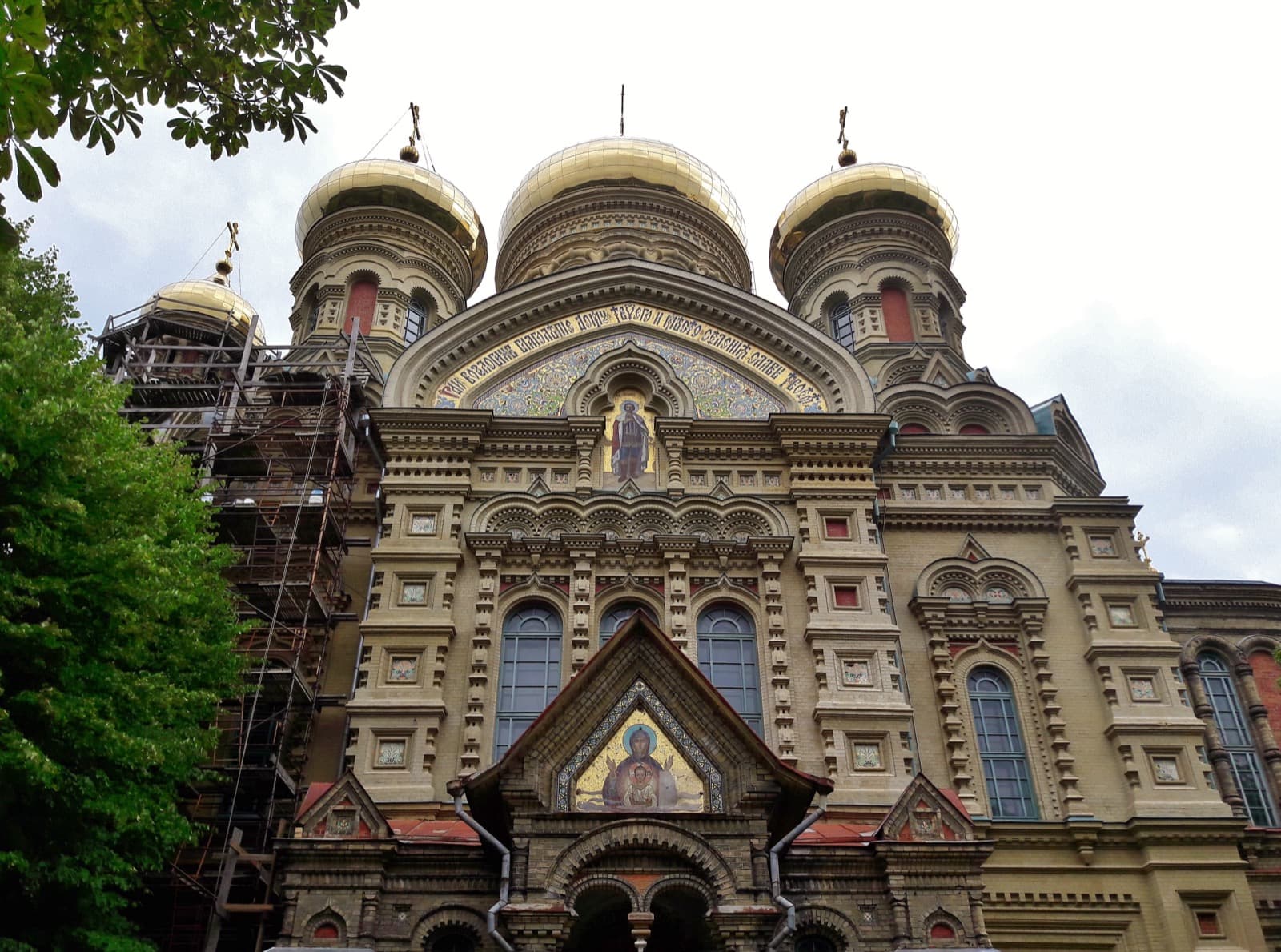
Karosta is unlike anywhere else in Latvia. Built from 1890 to 1906 as a closed, self-sufficient naval base for Tsar Alexander III, designed to house about 20,000 military personnel with its own power plant, water supply, schools and church, it mixes grand imperial officers' buildings and the star-shaped Northern Forts of the Liepāja Fortress, much of it dynamited and now collapsing into the sea, with plain Soviet-era apartment blocks and long stretches of dereliction.
Over it all rises the golden-domed St Nicholas Naval Cathedral. The scale is cinematic, and the contrast, an Orthodox cathedral beside Soviet prefab blocks, is the district's signature. It is reached across the Karosta Canal on the 1906 Oskars Kalpaks swing bridge, which opens for shipping, so the crossing can pause.
This is a real neighborhood as much as a ruin, and it deserves to be treated as one: people live here, and they have for decades.
Who lives here, and what the streets look like
A smaller, lower-income resident population lives in Karosta's Soviet-era blocks, purpose-built military housing that stayed occupied after the base was abandoned in the 1990s. Alongside the long-term residents is a thin seam of artists, tour operators and heritage projects working the cathedral, the prison and the forts.
The streets are wide, low-density and weather-exposed, part lived-in and part overgrown, with imperial masonry, Soviet concrete and open ground running together toward the dunes and the sea.
Getting around
Karosta is connected to the centre by the historic tram line, which was originally built to reach it, and by city buses No. 1 and No. 5, roughly 20 to 30 minutes to the prison stop. Access crosses the Karosta Canal on the Oskars Kalpaks swing bridge, which opens for shipping.
The honest reality is that Karosta is physically severed from the rest of the city by the canal and is the most isolated district in Liepāja, at the end of the line rather than in the thick of things.
Typical weekday minutes from Karosta, with the icon showing how. Times are indicative for a typical weekday, measured from the neighborhood centre; the icon shows the fastest sensible way. Minutes were measured with the Google Routes API for a typical weekday around 08:00., 2026-08.
Daily life
Everyday retail is thin. Karosta has some local grocers and shops for basics, but serious shopping, choice and services are back in the centre, so residents travel across the canal for most needs. For food delivery, Wolt and Bolt Food both cover Liepāja, but outlying Karosta can sit at the edge of the delivery area, so check the coverage before you rely on it. Be honest with yourself here: this is a district you shop out of, not into.
Local Places Worth Knowing
Independent and close by, chosen on merit. Nobody pays to appear here.
The 1903 golden-domed Orthodox naval cathedral, the visual heart of Karosta and still an active church.
A café at the Ziemeļu mols, on the Karosta shore. 4.4 on Google across 360 reviews.
Not in Karosta: the city's landmark 1910 market is a tram ride across the canal in the centre, where the real shopping happens.
View on Google MapsAlso in the centre, not Karosta: proper sit-down dining is a trip across the canal, as choice here is thin.
Checked August 2026. Places close and change, so tell us if something here is out of date.
Schools and families
A local school served the naval community, and Latvian towns give families broadly free school choice rather than one fixed catchment. Latvia publishes no usable per-school quality ranking: centralised-exam results by school exist, but they are not a like-for-like ranking. It is the sort of gap we would rather flag than fill, which is part of why we build these Liepāja guides the way we do. Check the specific schools and their admission, and weigh the isolation, before you sign a lease or purchase.
Kids Restricted. Lots of open space and dramatic heritage, but thin services, physical isolation across the canal and genuinely hazardous ruined forts make it a harder fit for young families than the centre.
Pet Friendly. Wide-open ground, dunes and the beach make for excellent walking, but the ruined forts and unsecured structures mean keep dogs leashed and clear of derelict and hazardous areas; city beach leash rules apply.
Green space, leisure and eating out
Karosta is open, wild and coastal. The Baltic beach and dunes run along its western edge, the ruined Northern Forts sprawl dramatically along the shore, and there is a great deal of open, low-density ground. The heritage sites are the draw: the cathedral, the museum prison, the forts and the canal. Eating out is minimal, tied mostly to the tour trade, and the city's manicured Seaside Park is back in the centre. A real word of caution: the ruined forts and unsecured structures are genuinely hazardous underfoot.
What it costs
Karosta is the cheapest place to live in Liepāja, reflecting the older Soviet stock and the district's isolation. Latvia does not publish a per-district figure, so we show the Liepāja city average of about 1 350 EUR / m² ≈ $140 / sq ft to buy (europropertydata / Latio, 2025 to 2026); Karosta sits at or well below that. For rent, classifieds put 2-room flats in the city from roughly 180 EUR / mo a month here at the low end, though there is no official per-city rent index so treat that as a market estimate.
Weather and climate
Seasonal averages for Liepāja, one representative month per season. LVĢMC 1991-2020 normals (Liepāja maritime station) via Wikipedia climate box; a mild, windy Baltic coast, milder winters than inland Latvia; the climate box gives annual sunshine (~1,940 hours) and annual rain-days (~115) only, so per-season sun-hours and rain-days are not separately published.
The honest downsides
Rough, isolated and part-abandoned. Karosta is cut off from the city by the canal, with stretches of dereliction, collapsing military ruins and thin services, and it carries a long-standing local reputation as a hard-up, edgy district. That reputation is anecdotal, not a published statistic, but the ruined forts and unsecured structures are a real physical hazard.
The most weather-exposed corner of a very windy city. It sits open to the Baltic with little shelter, and the Soviet-block housing stock is ageing, so both the setting and the buildings ask more of a resident than the sheltered centre does.
Crime and safety
Karosta reads as quiet and lived-in for its residents, but honesty matters here. Latvia publishes crime nationally and by police region, not per city district, so there is no standalone Karosta figure. The national count was 35,719 registered offences in 2023, up 5.6% on the year before, and Liepāja is policed by the Dienvidkurzeme district. Karosta's reputation as rough is reputation, not a per-district number. The fuller Liepāja picture is on the city safety page.
Is this you?
If you are drawn to imperial and military heritage, big coastal skies and the cheapest home in the city, and isolation and rough edges do not scare you off, Karosta is genuinely one of a kind. If you want services, choice and a walk-to-everything life, cross back to Vecliepāja in the centre, where the same city looks and lives completely differently.
Want to know what homes here are actually worth?
Join the waitlistHow we source this
How we put this together. Gathered on the ground by our local field team and written up by the Apraiz research team. Every figure above carries its own source and date. The scores are not computed by the build; walking and transport will use open map and transit data first, then Apraiz's own model. We update prices quarterly, transport and amenities twice a year, and school data when the source publishes.
Sources: liepaja.travel, dark-tourism.com, Wikipedia, europropertydata, Valsts policija.
Safety and crime in Liepāja →Nearby: Vecliepāja · Jaunliepāja