
Long Story ShortReadHide
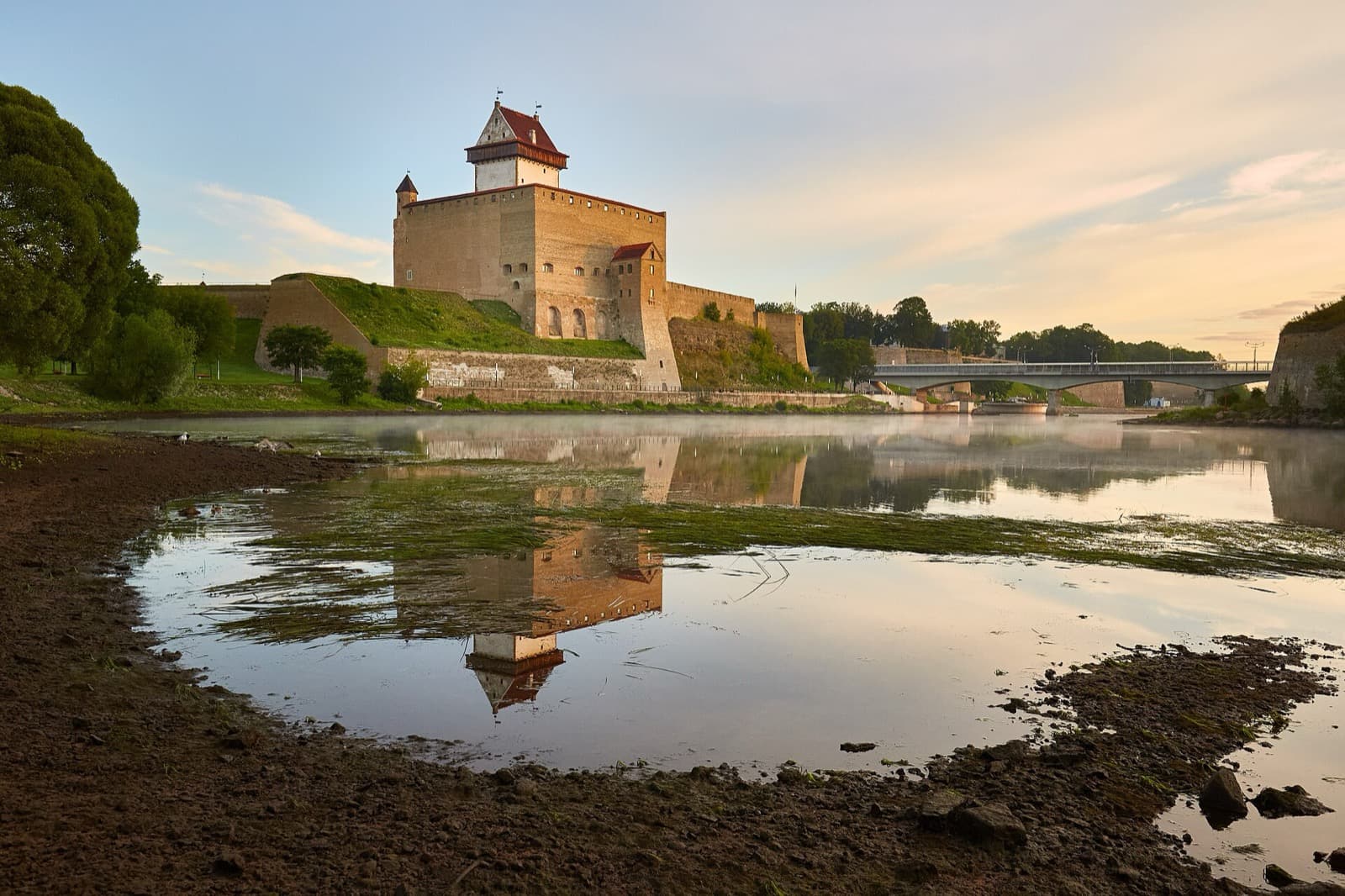
- What it is: Narva's compact centre, where the medieval Hermann Castle, the rebuilt baroque town hall, Peetri plats and a reworked riverside promenade meet the EU-Russia border, ringed by 1950s Soviet blocks.
- Who it suits: people who want a walkable, low-cost, deeply Russian-speaking border city with real history on the doorstep, and who do not mind that daily life runs far from Tallinn.
- What it costs: among the cheapest urban centres in the EU, roughly 463 EUR / m² ≈ $50 / sq ft to buy on the county anchor.
- What people complain about: the militarised border and the closed river crossing, and that beyond the castle and promenade the fabric is aging Soviet blocks with thin dining and retail.
First impressions
Two survivors dominate. The stone Hermann Castle, with its 51 metre Tall Hermann tower, stares across the river at Russia's Ivangorod fortress, and the 17th-century Narva Town Hall stands rebuilt a short walk away. Almost everything between them is broad Soviet avenue and apartment block, raised in the 1950s after about 98% of the city was destroyed in 1944. This is a historic heart in name, but the medieval old town it once had was demolished, not restored.
Today the centre is a walkable, Russian-speaking core of a few thousand people, anchored by the castle, the Fama Keskus shopping centre and a riverside that has been reworked into a modern promenade of nearly a kilometre, with terraces and a summer café below the bastions.
The honest caveat is the setting. The EU external border runs down the middle of the river through the city, the vehicle crossing has been shut since February 2024, and the cross-border life that once defined Narva is largely closed off.
Who lives here, and what the streets look like
The centre is home to the Russian-speaking majority that defines the whole city, Narva is about 95.7% native Russian speakers by the 2011 census, so daily life, signage and business run largely in Russian, with Estonian the official language. You find older long-settled residents, working families, and the small pool of officials, teachers and culture-sector workers drawn to the central institutions.
The streetscape is a mix that exists almost nowhere else. A genuine 13th-century castle and a restored baroque town hall sit among wide Stalin-era avenues and standard apartment blocks, and the river with its promenade gives the core its best face. It is compact and easy on foot, striking in places, plain in others.
Getting around
The centre is very walkable, castle to promenade to Fama on foot. Narva runs about 13 city bus routes, roughly twice an hour from around 06:00 to 23:00, paid by the Ühiskaart card rather than free. The Narva railway station sits in the centre with about five daily trains to Tallinn, a ride of roughly 2.5 hours. The border bridge is a short walk from Peetri plats, pedestrian-only since road traffic closed in February 2024.
The real distance downside is air travel. The nearest commercial airport of any scale is Tallinn Airport, about 210 km west, so there is no quick flight out.
Typical weekday minutes from Kesklinn, with the icon showing how. Times via Google Routes API for a typical weekday around 08:00, measured from the neighborhood centre; the icon shows the fastest sensible way., 2026-08.
Daily life
Everyday shopping is central and easy. Fama Keskus, with more than 80 shops and around 10,000 visitors a day, sits in the core, and Selver and Prisma grocers are close by. That covers daily needs well, though specialty and premium retail stay thin. For food delivery, Wolt and Bolt Food both cover Narva, restaurants and grocery including Selver, so delivery is real here even if the choice of venues is far smaller than Tallinn.
Local Places Worth Knowing
Independent and close by, chosen on merit. Nobody pays to appear here.
The 13th-century Danish-built border fortress and museum on Peetri plats, its Tall Hermann tower staring across the river at Ivangorod.
View on Google MapsA medieval-theme restaurant set inside the castle's round artillery tower, serving fish and meat with local ingredients.
Trading since 1947 with a preserved period interior, a proper old-school bakery-café for buns, pastries and coffee.
The central shopping centre with 80-plus stores and around 10,000 visitors a day, named after a 1690 bastion.
View on Google MapsChecked August 2026. Places close and change, so tell us if something here is out of date.
Schools and families
Several schools serve the centre, teaching largely in Russian and Estonian. Estonia publishes no per-school quality ranking. It is the sort of gap we would rather flag than fill, which is part of why we build these Narva guides the way we do. Check the specific schools and their admission before you sign a lease or purchase.
Kids Restricted. The castle, museum and river promenade are a real draw for a day out, but this is a dense, central border district of Soviet flats rather than a green family suburb.
Pet Restricted. The riverside promenade and the 2.5 km Joaorg trail are excellent for a dog, but homes here are dense Soviet flats with little private garden and few dedicated dog areas.
Green space, leisure and eating out
The waterfront is the draw. The Narva River Promenade and the 2.5 km Joaorg health trail run along the bank with castle and Ivangorod views, and the castle park, bastion gardens and a summer stage and café on the Sun Square fill out the leisure offer. Eating out is modest and centres on the castle and old-town core, with the medieval-theme Rondeel inside the fortress and the 1947 Narva Kohvik among the genuine local spots.
What it costs
Narva sits at the bottom of Estonia's housing market. Ida-Virumaa, Narva's county, had the country's lowest median apartment transaction price at about 330 EUR per square metre in 2023, and the lowest average asking price at roughly 463 EUR / m² ≈ $50 / sq ft in early 2026, a fifth to a quarter of the national level. No official per-district figure exists, so we anchor to the county band and flag that crowd-sourced Numbeo puts the Narva centre higher, around 958 EUR per square metre. Estonia publishes no official per-city rent either, so we show the Numbeo Narva-centre one-bed of about 227 EUR / mo as a market estimate.
Weather and climate
Seasonal averages for Narva, one representative month per season. Nearest official station Jõhvi (~50 km), Riigi Ilmateenistus 1991-2020; Narva daily high/low for winter and summer from aggregated climate data; spring and autumn daily high/low and sunshine are not separately published.
The honest downsides
It is a militarised border frontier. The EU external border runs through the city down the river, tank barriers and metal gates have gone in, and the vehicle crossing has been closed since February 2024, so the cross-border life that once defined the centre is largely shut.
Beyond the castle it is aging Soviet fabric. Away from the promenade and the fortress, the core is 1950s blocks with limited high-end retail, dining or nightlife, and the nearest real airport is about 210 km away in Tallinn.
Crime and safety
Estonia publishes crime only at county level, so there is no standalone Narva figure. Ida-Viru County, which contains Narva, recorded Estonia's highest rate in 2024 at about 326 crimes per 10,000 residents, against a national average near 206. That reflects the county's structural economic stress, including high unemployment, rather than a specific danger on any Kesklinn street, and no per-neighborhood breakdown exists to say the centre is better or worse.
Is this you?
If you want a walkable, very low-cost, Russian-speaking city with a real castle, a river promenade and history you can walk through, and the closed border and the distance from Tallinn do not put you off, the centre is Narva at its most characterful. If you want ordinary quiet block living close by rather than the frontier, Kalevi in eastern Narva is calmer and just as cheap.
Want to know what homes here are actually worth?
Join the waitlistHow we source this
How we put this together. Gathered on the ground by our local field team and written up by the Apraiz research team. Every figure above carries its own source and date. The scores are not computed by the build; walking and transport will use open map and transit data first, then Apraiz's own model. We update prices quarterly, transport and amenities twice a year, and school data when the source publishes.
Sources: Wikipedia, adaur.ee / KV.EE, ERR News (Statistikaamet).
Safety and crime in Narva →